


How to build a SaaS growth strategy
A SaaS growth strategy is a system for diagnosing and resolving the primary constraint holding back your business. It is not a list of marketing channels or a static plan, but a focused model that connects acquisition, activation, retention, and revenue to your unit economics. This framework guides your decisions on where to invest resources for the most significant impact.
Strategy is not a plan
Many teams conflate strategy with a plan. A growth plan lists activities: "We will spend $50k on paid search and hire two SDRs this quarter." A growth strategy provides the logic for those activities: "Our binding constraint is poor activation, so we will focus all resources on improving the new user experience before we invest in scaling top-of-funnel."
- Strategy is the diagnosis of the core challenge and the guiding policy for overcoming it. It defines the growth model itself.
- A Plan is the coordinated set of actions to execute the policy. It is tactical and time-bound.
Without a strategy, a plan becomes a random walk through popular channels, wasting capital and time.
A constraint-led framework for SaaS growth
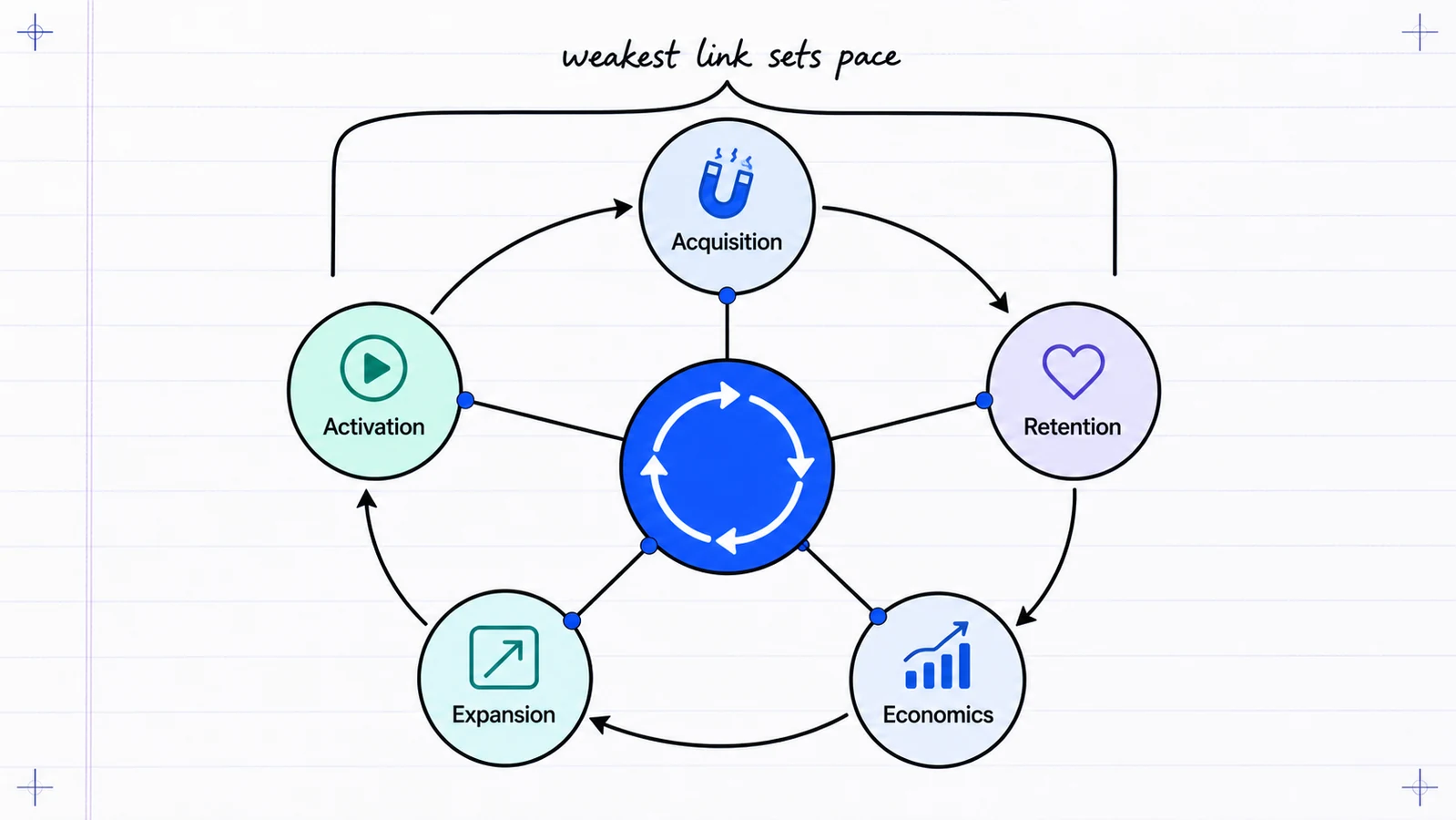
A durable growth strategy starts by identifying the single biggest leak in your customer lifecycle. It then applies a specific growth motion to fix that leak, ensuring the economics work before scaling. This process is a continuous loop, not a one-time setup.

1. Find your binding constraint
Growth is a system of interconnected stages. A problem in one stage invalidates success in the others. Pouring more leads into a product with high churn is like trying to fill a leaky bucket. Before choosing tactics, you must identify where the system is breaking.
The five primary constraints are:
* Acquisition: You cannot attract enough of the right potential customers.
* Activation: Users sign up but do not experience the product's core value.
* Retention: Activated users do not stick around long enough to be profitable.
* Revenue: Retained users do not convert to paid plans or expand their usage.
* Referral: The cost to acquire a customer is unsustainably high, and you have no organic growth loops.
Diagnose your constraint with data. Look at your funnel conversion rates, cohort retention curves, and unit economics.
2. Choose a primary growth motion
Once you know the problem, you can select the right motion to solve it. A growth motion is the primary way your company generates revenue. The main types are:
* Product-Led Growth (PLG): The product itself is the main driver of acquisition, activation, and expansion. This motion is effective for solving activation and retention constraints, as it focuses on user value first. Read more about product-led growth.
* Sales-Led Growth (SLG): A sales team guides customers from initial contact to close. This is often necessary for high-ACV products or complex enterprise sales where the constraint is revenue conversion for large accounts.
* Marketing-Led Growth (MLG): Content, advertising, and brand building generate demand that is captured by sales or a self-serve flow. This motion directly addresses acquisition constraints.
Your choice of motion should directly address your binding constraint. If activation is low, a sales-led motion might be a premature and expensive fix; a PLG approach to improve the product experience is likely the better strategic choice.
3. Connect the motion to unit economics
A growth strategy is only viable if the math works. You must connect your acquisition efforts to your revenue model through clear unit economics. The two foundational metrics are:
* Customer Acquisition Cost (CAC): The total cost of sales and marketing to acquire a single new customer.
* Lifetime Value (LTV): The total revenue a business can expect from a single customer account.

A healthy SaaS business typically aims for an LTV:CAC ratio of 3:1 or higher. Your strategy must outline how your chosen motion will achieve this. For example, a PLG strategy might aim for a very low CAC through viral loops, while a sales-led strategy justifies a high CAC with a much higher LTV from enterprise contracts.
4. Sequence and test your assumptions
Your initial strategy is a set of hypotheses. "We believe improving onboarding will fix our activation constraint, leading to better retention and a higher LTV." The final step is to turn these hypotheses into a sequence of experiments.

Instead of committing to a year-long plan, prioritize small, fast tests that validate or invalidate your core strategic assumptions. If the experiments work, expand them. If they fail, your strategy was wrong, and you can return to the diagnostic phase without having wasted a year's budget.
A diagnostic map for your next growth move
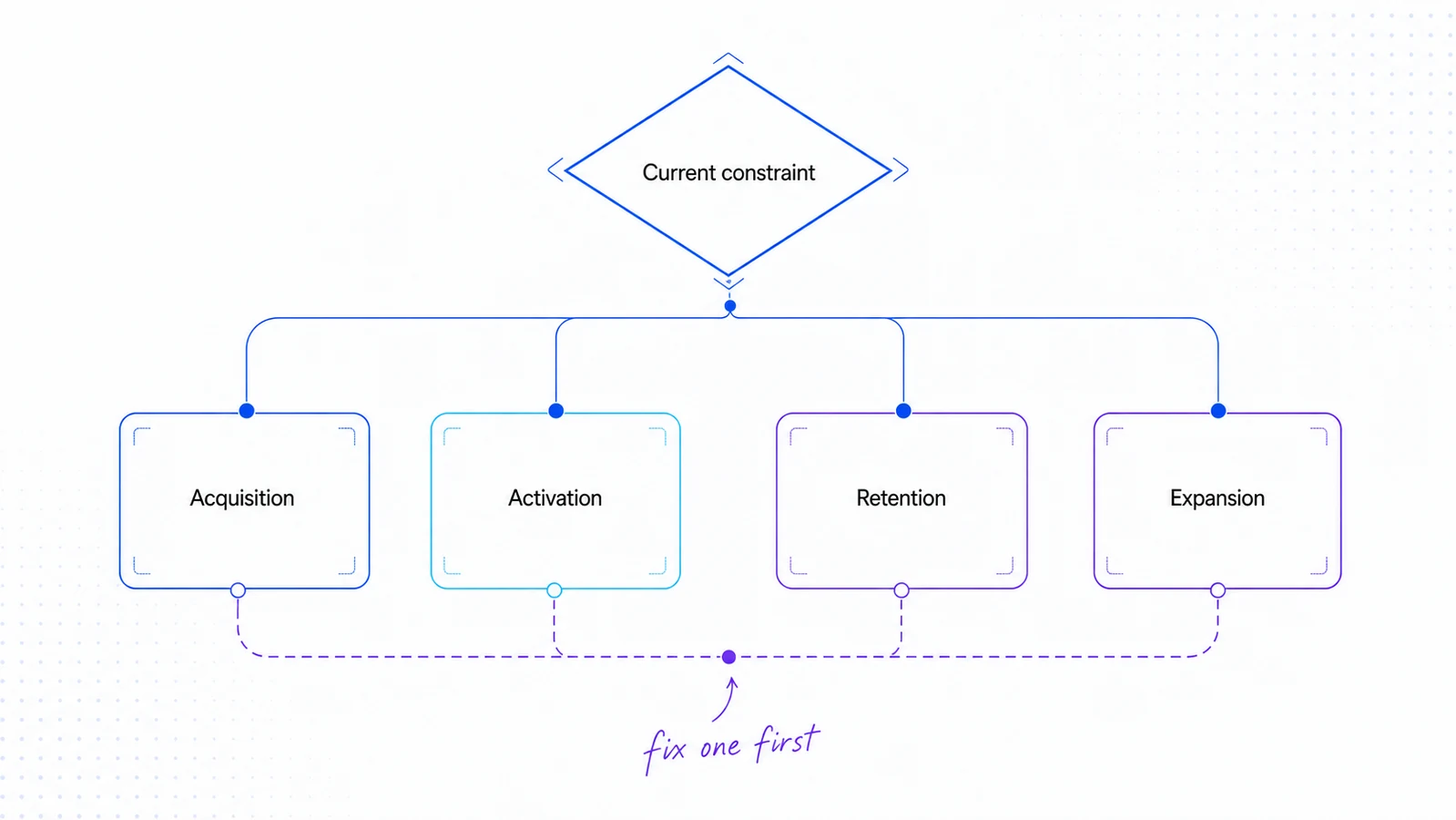
To make this framework operational, use a diagnostic map to pinpoint your constraint and identify the corresponding strategic lever. Ask the following questions in order. Stop at the first "no" and focus your strategy there.
1. Is your LTV > 3x your CAC?
* No: Your business model is unsustainable. The binding constraint is Economics. Your strategy must focus on increasing LTV (through higher prices, expansion revenue, or better retention) or decreasing CAC (through more efficient channels or viral loops). Do not scale acquisition until this is fixed.
2. Does a healthy percentage of new users from month one still use the product in month three?
* No: Your product is a leaky bucket. The binding constraint is Retention. Your strategy must focus on improving core product value, user engagement, and customer success. Analyze churned users to understand why they leave. Net Revenue Retention (NRR) is a key indicator of health here.
3. Do new users consistently reach the "aha" moment (the point where they understand the core value)?
* No: Users don't understand how to get value from your product. The binding constraint is Activation. Your strategy should center on improving the first-time user experience: better onboarding, clearer UI, tutorials, or a free trial/freemium model that guides users to value.
4. Are you generating a predictable number of qualified leads, signups, or demos each month?
* No: You cannot attract the right audience. The binding constraint is Acquisition. Now, and only now, is it time to focus your strategy on top-of-funnel channels. This could involve content marketing, paid advertising, outbound sales, or partnerships.
If you can answer "yes" to all of these questions, your primary constraint is likely Expansion. Your strategy should focus on moving happy, retained customers to higher-value plans or getting them to use more of your product.
Example: How Figma's strategy addressed its constraints
Figma, the collaborative design tool, provides a clear example of a strategy evolving to address different constraints over time.
- Initial Constraint: Activation and Retention. Early design tools were desktop-based and siloed. Figma’s core hypothesis was that browser-based, collaborative design would be stickier. Their initial strategy was pure product-led growth. They focused on creating an exceptional user experience that led designers to an "aha" moment when they collaborated with a teammate in real time. This solved the activation and retention problem first.
- Next Constraint: Acquisition. With a sticky product, the next constraint was getting it into the hands of more users. Their PLG motion created a powerful referral loop. Every time a designer shared a file with a stakeholder (a product manager, engineer, or client), they exposed a new potential user to the product. This viral mechanic drove low-cost acquisition.
- Final Constraint: Revenue and Expansion. Once Figma had massive adoption within teams and companies, the constraint became monetizing that usage. They introduced a sales-led motion with Figma Enterprise to sell to large organizations. This strategy did not replace the PLG engine; it layered on top of it. The bottom-up adoption created by the product-led motion generated warm, qualified leads for the enterprise sales team.
Figma’s success came from sequencing its strategy correctly: first, make a product people love and retain; second, build a low-cost way to acquire more users; and third, build a sales motion to capture enterprise value.
Common mistakes in building a growth strategy
Many SaaS companies stumble by making one of these common errors.
- Chasing Tactics, Not Strategy: Teams jump directly to discussing channels ("Should we do TikTok or LinkedIn ads?") without first diagnosing their core constraint. This leads to wasted spend on channels that attract users who will churn anyway.
- Scaling Acquisition Prematurely: The most common mistake is pouring money into ads or sales to grow the top of the funnel when the product has a retention problem. As Paul Graham of Y Combinator noted, it's often better to have "100 customers who love you" than 1,000 who kind of like you.
- Ignoring Unviable Unit Economics: A strategy that acquires customers at a loss is not a strategy; it's a countdown to failure. The relationship between LTV and CAC must be a central part of any growth discussion.
- Keeping the Same Strategy Too Long: The constraint that matters at $1M in Annual Recurring Revenue (ARR) is different from the one that matters at $50M ARR. A growth strategy is a living document that must adapt as the business and market change. As companies scale, tracking revenue metrics like Monthly Recurring Revenue (MRR) and ARR becomes critical for guiding these strategic shifts, as detailed by resources from both Stripe and Paddle.
A disciplined growth strategy avoids these errors by forcing a deliberate, evidence-based approach to identifying and solving the single most important problem at any given time.
FAQ
What is a SaaS growth strategy?
A SaaS growth strategy is a framework for identifying the single biggest bottleneck to your company's growth, whether in acquisition, activation, retention, or revenue, and applies a focused set of actions to resolve it. It connects your product, market, and go-to-market motion to a sustainable economic model.
What are the key metrics for a SaaS growth strategy?
Key metrics include Customer Acquisition Cost (CAC), Lifetime Value (LTV), Monthly Recurring Revenue (MRR), Annual Recurring Revenue (ARR), Net Revenue Retention (NRR), and customer churn rate. The most important metric depends on your current binding constraint.
How does growth strategy differ for early-stage vs. scaled SaaS companies?
Early-stage companies typically focus their strategy on solving activation and retention to achieve product-market fit. Their goal is to build a product that a core group of users loves. Scaled companies often shift their strategic focus to acquisition efficiency, market expansion, and increasing LTV through new products or enterprise sales motions.
What are the main types of SaaS growth models?
The primary models are product-led growth (PLG), where the product drives adoption; sales-led growth (SLG), where a sales team drives revenue; and marketing-led growth (MLG), where marketing programs generate demand. Many successful companies use a hybrid model, such as a PLG foundation with a sales-assist layer for larger customers.
How often should you review your growth strategy?
A growth strategy should be reviewed quarterly. While the core principles may remain stable for longer, the binding constraint can change quickly as you grow. A quarterly review allows you to assess whether your experiments are working and to realign your priorities based on new data.