
Sales funnel
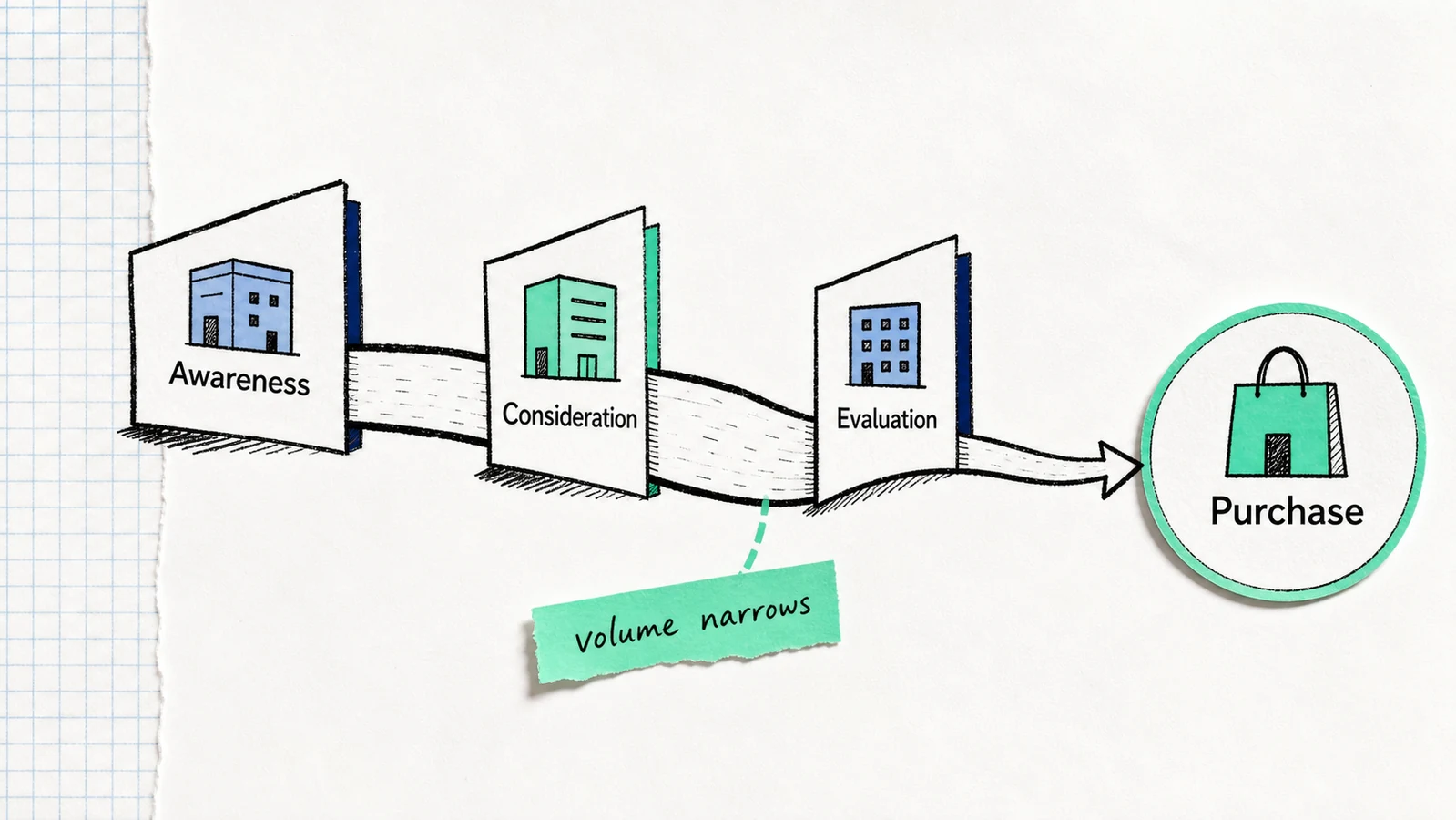
A sales funnel is a model that shows how a broad group of potential buyers narrows as they move through stages such as awareness, consideration, evaluation, and purchase. It helps a company measure how many people or accounts reach each stage and how effectively they move forward.
The funnel is a measurement view of buyer progression. A sales pipeline is usually an operational view of specific opportunities, owners, next steps, and forecast value.
In SaaS, the funnel may include website visitors, signups, qualified leads, meetings, opportunities, customers, and retained accounts, depending on the motion.
Why it matters
Revenue growth is shaped by conversion across several stages. More traffic does not help much if the company attracts the wrong audience. More meetings do not help if qualification is weak. More customers can be expensive if retention is poor.

The sales funnel helps a GTM team identify where volume disappears and whether that drop is expected. It connects marketing, sales, product, and revenue operations around the same progression.
Funnel data also helps the team choose the right problem. A low visitor-to-signup rate may point to targeting or positioning. A low opportunity-to-close rate may point to qualification, proof, pricing, or sales execution.
How it works
The company first defines stages that reflect meaningful buyer progress. Each stage needs a clear event or rule so the same account is not counted differently by each team.
Then it measures three things: volume at each stage, conversion between stages, and time spent moving through them.
An inbound sales funnel may start with content engagement, demo requests, or product signups. An outbound sales funnel may start with target accounts, reached contacts, conversations, meetings, and opportunities.
The exact shape matters less than consistent definitions and honest data.
Stage definitions should stay stable long enough for conversion comparisons to remain useful.
SaaS example
Imagine a SaaS company with 10,000 monthly visitors, 500 trial signups, 150 activated accounts, 40 qualified sales conversations, and 10 new customers.
The funnel shows where the largest losses occur. If signups are healthy but activation is weak, buying more traffic may increase acquisition cost without improving revenue. The team should inspect onboarding, product fit, and the promise made before signup.
Common mistakes
The first mistake is using stage names with no shared definition.
The second mistake is mixing people, accounts, and opportunities in one calculation without explaining the unit.
The third mistake is optimizing one conversion rate while damaging quality later in the funnel.
The fourth mistake is treating every drop as a problem. A good qualification stage should remove poor-fit demand.
How we see it
A sales funnel should expose where the revenue motion loses the right buyers. Raw volume is useful, but the better question is whether qualified buyers are progressing with less friction and better economics.