


Intent data
Intent data is behavioral information that may indicate a person or company is researching a problem, topic, category, product, or vendor. Revenue teams use it to identify potential buying activity, prioritize accounts, time outreach, and choose a relevant message.
Intent data does not confirm that an account will buy. It is a signal that needs account fit, recency, source quality, and business context before the team acts.
Why it matters
Static account data explains who a company is. Intent data adds evidence about what the account may be paying attention to now.
That can make outbound sales more selective. A BDR can focus on high-fit accounts showing sustained research instead of contacting every company in a database.
Intent can also support advertising, nurture, account prioritization, expansion, and lead scoring. Its value depends on whether the team can connect the signal to the right account and create a sensible next action.
Early research is a real part of the buying path. 6sense's 2025 Buyer Experience Report found that first seller contact occurred 61 percent of the way through the reported journey on average in a study of just under 4,000 B2B buyers across North America, APAC, and EMEA. That creates a reason to observe research patterns before a hand raise, but it does not make any single signal proof of purchase readiness.
How it works

Intent data is usually grouped by source.
First-party intent comes from properties the company controls: website visits, product activity, email engagement, event attendance, chat, form submissions, and content downloads.
Partner or second-party intent comes from another organization that shares its own audience activity, such as a review site, publisher, event partner, or marketplace.
Third-party intent is collected or aggregated across broader networks and mapped to companies, topics, or categories.
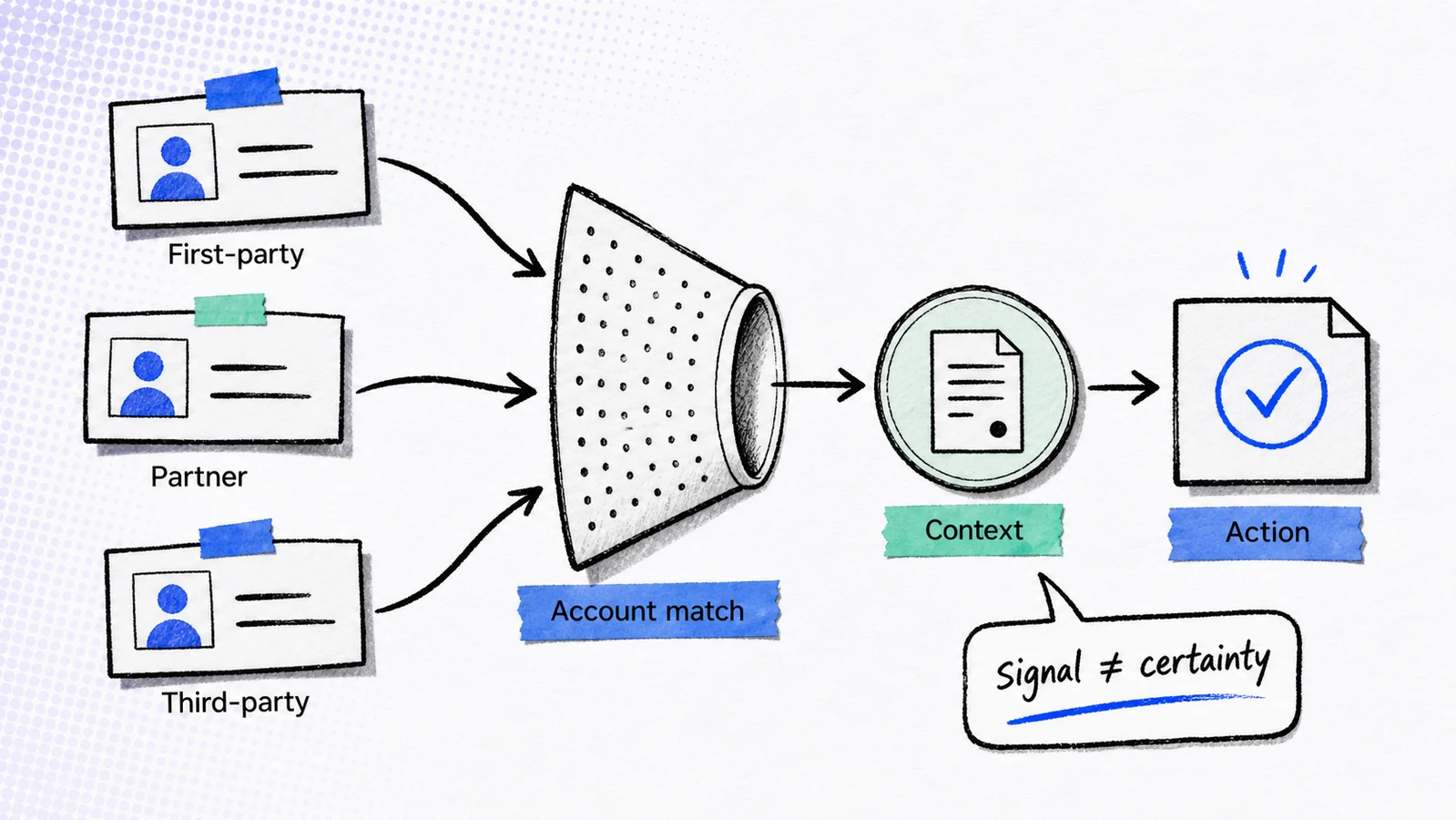
Providers may score activity using volume, recency, topic relevance, frequency, and how unusual the behavior is compared with a baseline. Account matching can use domains, IP resolution, cookies, identity graphs, or known contacts, each with different limits.
The signal becomes more useful when combined with data enrichment, ICP fit, CRM history, and current opportunity status.
SaaS example
Imagine several people from a target account repeatedly viewing CRM migration content, comparing data-quality tools, and visiting an integration page. That pattern may justify account research.
Sales should still check whether the company is a customer, an active opportunity, a competitor, or a poor fit. The message should connect to a credible observation without claiming to know private browsing behavior.
Common mistakes
The first mistake is treating one topic spike as purchase intent.
The second mistake is routing raw signals directly to sales with no account context.
The third mistake is hiding source quality or account-matching confidence.
The fourth mistake is using intent language that makes buyers feel monitored.
How we see it
Intent data is useful when it improves timing and prioritization. It becomes harmful when a probabilistic signal is presented as certainty or used to justify irrelevant outreach.
Teams should also decide how quickly each signal expires. Recency, frequency, and source reliability determine whether a behavior deserves action today or belongs in historical context. Document those rules so marketing, sales, and RevOps interpret the same signal consistently.