


What is hybrid pricing?
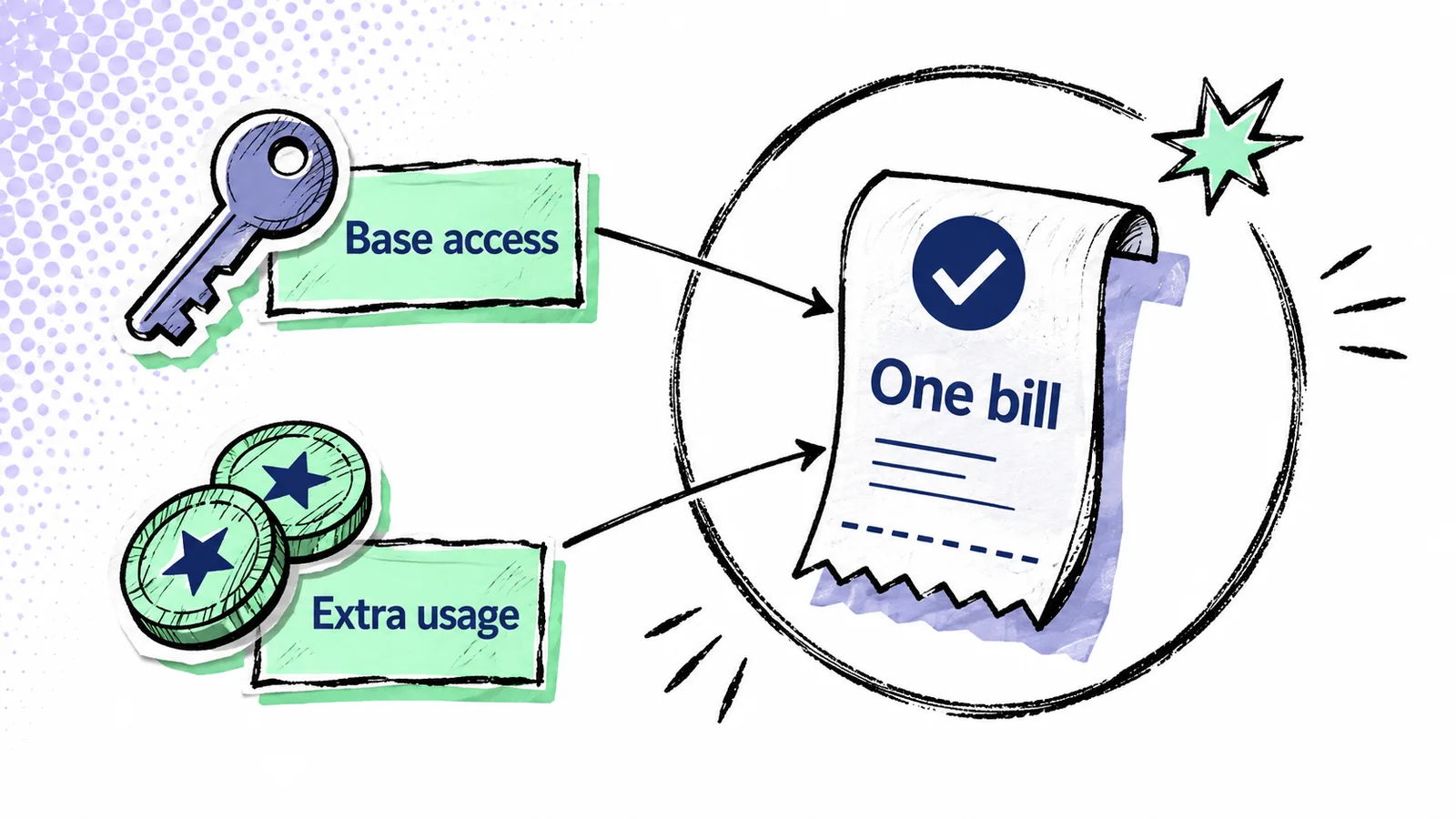
Hybrid pricing combines distinct charging structures in one product offer. In SaaS, a common version pairs a recurring access fee with a variable usage charge. Other combinations can include seats, metered consumption, outcome charges, or separately priced capabilities.
The defining feature is the combination of charging rules. Offering monthly and annual payment for the same plan does not, by itself, create a hybrid model.
Why hybrid pricing matters
A fixed component can cover continuing access and establish a minimum contractual charge. A variable component lets the invoice change as the customer consumes more of the product.
That combination can suit products whose ongoing platform value and consumption costs behave differently. It also creates two questions for the buyer: what does the base fee buy, and what causes additional spending?
Within a SaaS pricing strategy, those questions should have separate answers. A vendor should be able to explain each charge without using the existence of the other as justification.
The recurring component can support planning, but the entire invoice is not necessarily predictable. A customer may know the minimum and still face substantial usage variation.
How hybrid pricing operates
Begin with the base entitlement. Specify the access, capabilities, seats, or included allowance that the fixed payment purchases. Clarify the billing period and what happens when the subscription changes.
Then define the variable component. Name its unit, rate, aggregation period, and exclusions. If the plan includes usage, show exactly where included consumption ends and additional charges begin.
Check the interaction between the components. Included units must not be billed again as excess units. If allowances reset, expire, or roll over, those rules affect the customer's estimate and should be explicit.
Next, make the final invoice explainable. Present the base charge and variable charge separately, with enough supporting quantity information to reconcile the total.
Commercial reporting also needs the distinction. ACV should reflect a clearly stated annual contract-value convention. An uncertain usage estimate is different from a committed minimum, even when sales presents both in a proposal.

A SaaS example
Consider an illustrative automation platform with a $200 monthly base fee. The plan includes 10,000 eligible runs. Additional runs cost $0.01 each.
A customer completes 14,000 eligible runs in a month. The first 10,000 are covered by the base plan. The remaining 4,000 create a $40 usage charge, making the total $240.
If the customer completes only 8,000 runs, the bill remains $200 under this fictional agreement. Unused allowance does not generate a refund or carry forward.
The example is hybrid because one component pays for the plan and another prices consumption above its allowance. A set of flat subscription tiers with hard limits and no additional charge rule would be a different structure.
As eligible usage rises, the variable component can generate expansion revenue. The team still needs to understand whether that increase is recurring behavior, seasonal demand, or a one-time event.
Common mistakes
Adding charges until margins look acceptable can produce a bill buyers cannot explain. Each component should correspond to a distinct entitlement or scaling rule.
Another mistake is concealing the allowance boundary. A plan that appears fixed-price can create distrust when an unexpected variable component arrives later.
Treating every extra charge as guaranteed recurring revenue also weakens forecasting. Keep commitments and variable estimates separate, and have RevOps reconcile the proposal, product entitlements, and billing configuration.
Before adding another component, write its buyer-facing reason in one sentence. Then calculate bills for low, typical, and high consumption using actual customer patterns. If the explanation or the arithmetic becomes difficult to follow, simplify the offer before changing the price.
For more practical SaaS packaging guidance, join the newsletter below.