


What is outcome-based pricing?
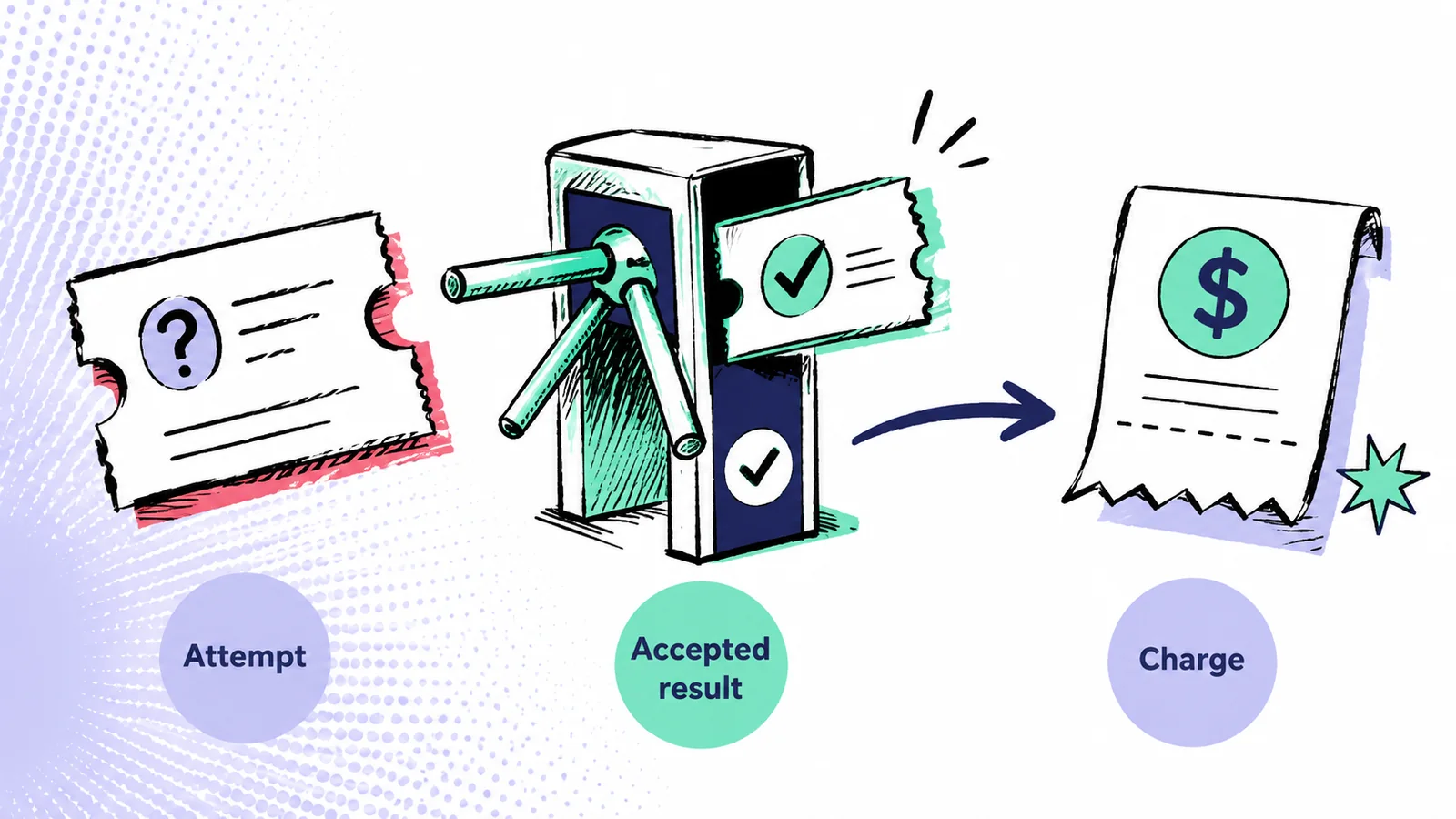
Outcome-based pricing ties a charge to an agreed, measurable result. The customer pays when the product delivers a qualifying outcome, such as an accepted support resolution, rather than simply paying for access, processing time, or the number of attempts.
The agreement determines what counts. A resolved conversation, a qualified prospect, and a recovered payment are different outcomes with different acceptance rules. None automatically proves that the customer achieved every broader business goal.
Why outcome-based pricing matters
This model brings the commercial promise closer to the customer's reason for buying. A buyer can evaluate the cost of a useful result instead of translating software activity into a business case.
It also changes the vendor's responsibility. Failed attempts can consume infrastructure and support capacity without creating a billable event. The seller needs to understand those costs before choosing a rate.
Within a SaaS pricing strategy, outcome-based pricing is a charging rule. Value-based pricing is a method of setting prices according to customer-perceived value. A company can use value-based reasoning to set a flat subscription without charging per outcome.
How outcome-based pricing operates
Start with the event. Specify what must happen, whose result it represents, and which evidence confirms completion. Translate the value proposition into a billable unit that both parties can inspect.
Then define exclusions. An abandoned attempt, duplicate request, human escalation, or reversed result may be excluded, depending on the agreement. Do not assume that every vendor uses the same rule.
Next, decide the acceptance window. Some results are confirmed immediately; others require a period in which the customer can dispute or reopen the case. Document how a reversal changes the invoice.
Finally, retain the evidence behind each charge. A billing record should connect the customer, unique event, acceptance rule, and applicable rate. The customer should not need a sales call to understand why an item appeared.
The acceptance rule also gives customer success a useful boundary. Helping customers reach their broader goals remains important even when a narrower event qualifies for billing.

A SaaS example
Consider an illustrative support product charging $2 per accepted resolution. Its fictional contract excludes cases handed to a human and counts each accepted case once.
During a billing period, the product handles 500 cases. Of those, 400 meet the acceptance rule and 100 require escalation. The outcome charge is $800: 400 accepted resolutions multiplied by $2.
The 500 attempts still matter to the vendor's operating costs. They do not all belong on the customer's outcome invoice.
If the agreement instead recognizes a completed handoff as a billable outcome, the same activity could produce a different bill. The label on the pricing page cannot settle that distinction. The event definition must.
Common mistakes
Calling every completed task an outcome weakens the model. A generated report may be useful, but its creation is not necessarily the customer's desired result.
Promising revenue impact that the product cannot isolate creates another problem. Sales, customer execution, market conditions, and product behavior may all influence the final result. Choose a measurable event within the product's influence, or make shared responsibilities explicit.
Hiding disputed events inside a monthly total makes reconciliation harder. RevOps should connect the agreement, event evidence, and billing treatment so teams can resolve exceptions consistently.
Before quoting a price per outcome, define the rejection path. What happens when the customer says the result did not qualify? A clear answer makes the pricing promise credible.
For more practical SaaS pricing guidance, join the newsletter below.