


ACV
ACV means annual contract value. It is the recurring value of a customer contract normalized to one year.
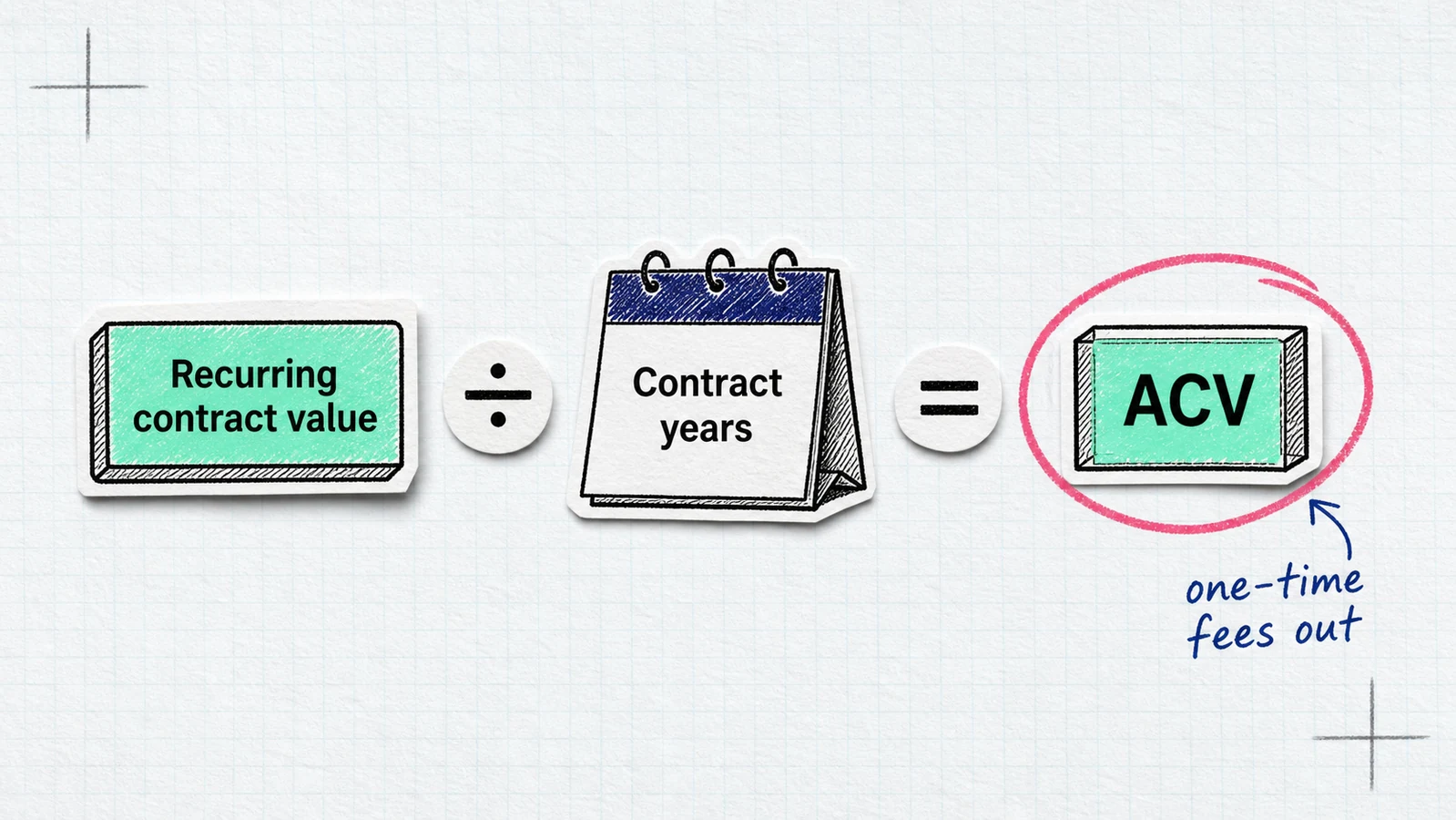
For a multi-year SaaS agreement, a common formula is:
ACV = total recurring contract value / contract years
One-time implementation, training, hardware, or professional-service fees are usually excluded unless the company explicitly defines ACV differently.
ACV is different from total contract value, which measures the full value committed across the contract term. It is also different from annual recurring revenue, which is a company-level recurring revenue measure rather than a contract-level view.
Why it matters

ACV helps a company compare contracts with different terms on the same annual basis. A one-year agreement and a three-year agreement can then be analyzed without confusing contract length with customer size.
The metric affects sales capacity, pricing, acquisition economics, and service level. Higher-ACV deals may support an account executive, solution support, procurement work, and longer sales cycles. Lower-ACV deals may need a simpler or product-led motion.
ACV also helps teams compare segments and understand whether growth comes from more customers, larger contracts, or both.
Peer context can differ materially. SaaS Capital's 2025 analysis reported a median ACV of $23,391 for bootstrapped companies and $35,761 for equity-backed companies in its 2024 survey of private B2B SaaS businesses with more than $1 million in ARR. The comparison does not make either value a target or show that funding caused the difference. It shows why a blended SaaS median needs a clearly defined segment.
How it works
First, identify the recurring contract components. This may include subscription licenses, platform fees, seats, usage commitments, or recurring support.
Second, remove one-time fees unless the company's metric policy includes them.
Third, divide the recurring contract value by the number of contract years.
For contracts shorter than a year, teams may annualize the value, but they should label that assumption clearly. Usage-based contracts may require committed minimums or historical consumption rather than a fixed subscription amount.
ACV should use the same definition across CRM records, finance reports, and RevOps dashboards.
Teams should also decide how renewals, upgrades, discounts, and variable usage commitments affect the reported amount. That shared policy prevents the metric from changing between departments.
The same policy should apply across every contract report.
SaaS example
Suppose a customer signs a three-year recurring contract worth $90,000, plus a one-time $6,000 implementation fee. The recurring ACV is $30,000. The total contract value may include the implementation fee, but ACV normally does not.
That $30,000 annual value can be compared with the customer's acquisition cost, gross margin, expected LTV, and sales effort.
The same metric can help inspect the sales pipeline: are larger contracts progressing differently, taking longer, or closing at a lower rate?
Common mistakes
The first mistake is using ACV and annual recurring revenue as interchangeable terms.
The second mistake is including one-time fees without documenting the choice.
The third mistake is averaging radically different customer segments into one number.
The fourth mistake is reading ACV without CAC, margin, retention, and delivery cost.
How we see it
ACV is a normalization tool. It becomes useful when it helps the company match contract value with the right sales motion, cost structure, and customer experience.