


How to create a go-to-market plan
A go-to-market plan translates your GTM strategy into an operational document. TechTarget defines a GTM strategy as the action plan for reaching target customers; the working plan makes its owners, timing, and evidence explicit. It details the specific actions, owners, timelines, budget, and metrics required to find, attract, and win your target customers. The plan’s purpose is to create a single, executable record of truth for the entire GTM team.
Unlike a go-to-market strategy, which defines the what and why of your market approach, the plan focuses on the how, who, and when. The strategy identifies the target market and value proposition; the plan specifies the budget for a particular sales channel, the owner of a Q3 demand generation campaign, and the milestones for entering a new market segment.
Many organizations treat the plan as a static slide deck or a simple checklist for a product launch. This approach fails because markets provide constant feedback. An effective go-to-market plan is a working document used for making decisions, testing hypotheses, and learning from evidence. It connects high-level strategy to the day-to-day work of marketing, sales, and product teams.
The architecture of an executable GTM plan
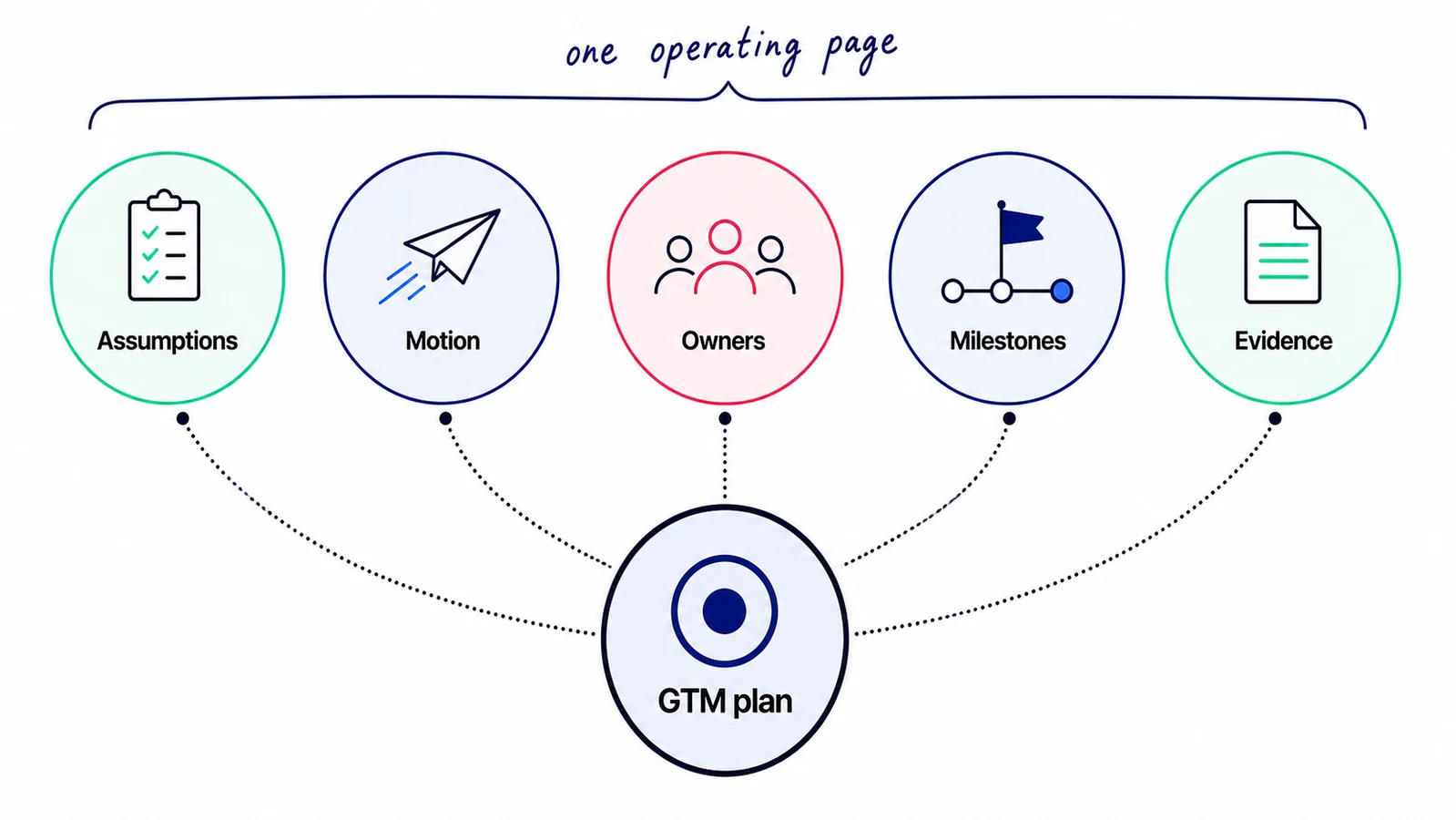
An executable plan is built on four connected components: foundational assumptions, the core GTM motion, execution and ownership, and measurement. Each component contains a set of strategic choices that must be made explicit.
1. Foundational assumptions
This section documents the core hypotheses the plan is built on. Getting these assumptions wrong invalidates the rest of the plan, so they must be clear, specific, and falsifiable.
- Ideal Customer Profile (ICP): Who is the specific customer? Document the firmographics (company size, industry, revenue) and the specific buyer persona (title, role, pain points) you are targeting. A sharp ICP definition is the foundation for all messaging and targeting.
- Problem and Value Proposition: What specific problem does the ICP have that you solve? Your value proposition must clearly articulate the outcome your product delivers, in the customer’s language. For example, "Reduces API security incidents by 90%" is stronger than "An advanced API security platform."
- Market Segmentation and Sizing: Which specific slice of the market are you targeting? Define your segment with clear boundaries. This process of market segmentation helps focus resources where they have the highest probability of success. Include an honest assessment of the market size and your serviceable obtainable market (SOM).
2. The core GTM motion
This component details the channels and tactics you will use to engage your ICP and convert them into customers. Early-stage companies often need to test multiple motions before finding one that is repeatable and scalable.
- Channels and Funnel: What are the primary channels for reaching customers? This could be outbound sales, content and SEO, paid acquisition, partnerships, or a product-led growth (PLG) model. Map out the expected customer lifecycle through your sales funnel, from initial awareness to closing a deal.
- Messaging and Positioning: How will you communicate your value proposition in each channel? Develop core messaging pillars and positioning statements that differentiate you from competitors. This messaging gives sales conversations, ads, and landing pages a consistent claim to make and prove.
- Pricing and Packaging: How is the product priced and sold? The pricing model (e.g., subscription, usage-based, per-seat) and package tiers should align with the value provided to the customer. As noted in guidance from Stripe, pricing is a critical part of the GTM motion that directly impacts revenue and customer perception.
3. Execution and ownership
A plan without owners is just a wish list. This section assigns clear accountability for every major initiative and resource.

- Team and Roles: Who is responsible for each part of the plan? Define the roles and responsibilities for marketing, sales, customer success, and product. For startups, a founder may own multiple roles initially. The key is to name a Directly Responsible Individual (DRI) for every key result.
- Budget and Resource Allocation: What is the budget for the GTM motion? Allocate specific dollar amounts to headcount, marketing programs, sales tools, and other expenses. The budget should directly correspond to the milestones and metrics you aim to achieve.
- Timeline and Milestones: What are the key milestones over the next 30, 60, and 90 days? Break the plan into a series of time-bound objectives. Milestones could include "achieve 100 demo requests in Q1," "hire two account executives by June," or "close three enterprise design partners."
4. Measurement and evidence
This final component turns the plan into a learning system. It defines what success looks like and establishes a process for reviewing progress and making adjustments.

- Key Metrics and KPIs: What are the 3-5 metrics that define success for this plan? Distinguish between lagging indicators (like revenue and churn) and leading indicators (like pipeline generated, sales cycle length, and demo-to-close rate).
- Data and Tooling: What is the system for collecting and analyzing GTM data? This includes your CRM, marketing automation platform, and product analytics tools. The goal is to have a reliable dataset for measuring performance against the plan.
- Feedback Loops: How and when will the team review progress? Establish a regular cadence (e.g., weekly GTM meetings, monthly plan reviews) to assess what is working, what is not, and what needs to change.
A concrete SaaS example: AuditLog
To make this framework practical, consider a hypothetical B2B SaaS company called AuditLog. It provides compliance automation software for mid-market fintech companies.
Here is a simplified version of its GTM plan:
- ICP: Head of Compliance or CTO at a Series B-D fintech company in North America with 100-500 employees. This persona is overwhelmed by manual evidence collection for SOC 2 and ISO 27001 audits.
- Value Proposition: "Automate 90% of compliance evidence collection and reduce audit preparation time from three months to two weeks."
- Core Motion:
- Phase 1 (First 6 months): Founder-led outbound sales targeting the team’s personal networks and high-fit companies. The goal is to secure 10 early customers and refine the value proposition.
- Phase 2 (Next 12 months): Hire two Account Executives to scale the outbound motion. Launch a content strategy focused on highly technical whitepapers and webinars targeting compliance professionals.
- Key Milestones (Q1):
- Sign 5 paying customers with an average contract value of $25k.
- Generate 50 qualified sales meetings from founder outreach.
- Publish two technical whitepapers on SOC 2 automation.
- Budget (Q1): $150k allocated for one AE salary, sales tools (CRM, sales intelligence), and initial content marketing production.
- Metrics:
- Leading: Number of sales qualified leads (SQLs) generated per week, sales pipeline created.
- Lagging: New monthly recurring revenue (MRR), customer acquisition cost (CAC).
- Feedback Loop: A bi-weekly GTM meeting where the founder and AE review pipeline, conversion rates, and qualitative feedback from sales calls to identify objections and refine messaging.
From static document to active learning system
The most common failure point of a GTM plan is treating it as a one-time deliverable. Market conditions change, customer needs change, and initial assumptions are often wrong. The plan must be designed to accommodate this reality.

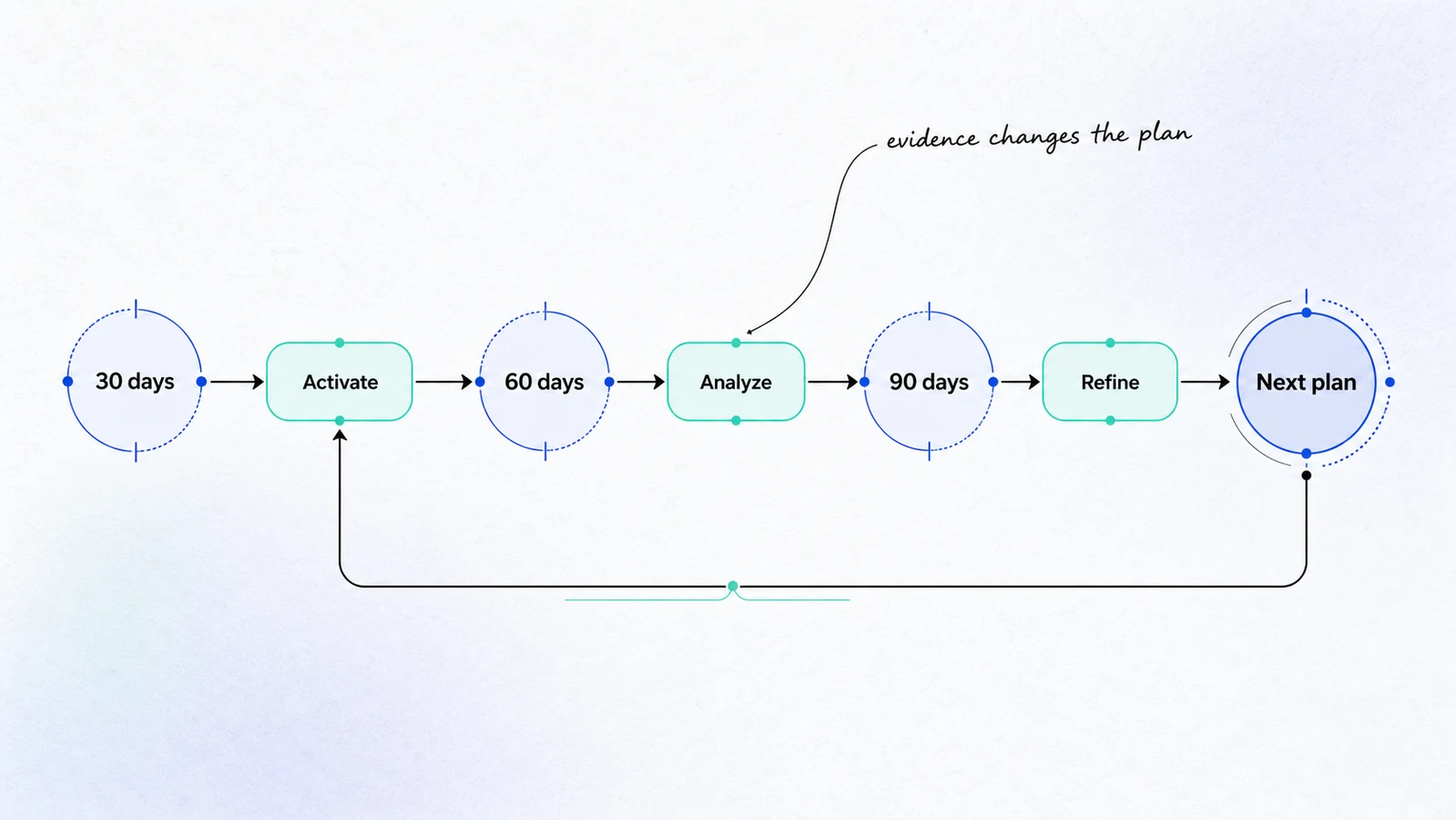
This requires shifting from a "set it and forget it" mindset to a continuous loop of execution and learning. A 30-60-90 day structure is a practical way to implement this.
- First 30 Days: Focus on activating the plan. Launch initial campaigns, start outreach, and ensure the data collection systems are working correctly. The goal is to generate early data and feedback.
- First 60 Days: Analyze the initial results. Are you hitting your leading indicators? Are the messaging and channels resonating with the ICP? Keep what is working and stop what is not.
- First 90 Days: Refine and optimize. Use the evidence gathered over the first 60 days to update the plan for the next quarter. This could mean adjusting the ICP, changing the marketing budget allocation, or modifying the sales process.
This iterative approach, often documented in templates like those found on sites like PM Read, turns the GTM plan from a static artifact into the operating layer for your entire revenue engine. It builds a disciplined process for learning and adapting, which is the most critical capability for any company finding its place in the market.
How we see it
A go-to-market plan is more than an action list; it is a record of your strategic bets. By making your assumptions, owners, and metrics explicit, you create a system for testing those bets against market reality. A great plan does not guarantee success, but it creates the conditions for rapid learning. It provides the structure needed to discover a repeatable and profitable GTM motion before you run out of resources.
FAQ
What is the difference between a go-to-market strategy and a GTM plan?
A GTM strategy defines your high-level approach: which markets to enter, who your target customers are, and how you will position your product to win. A GTM plan is the operational blueprint that details the specific actions, resources, owners, and timelines required to execute that strategy. Strategy is the why, and the plan is the how.
Who should own the go-to-market plan?
In an early-stage startup, a founder (often the CEO) typically owns the GTM plan. As the company scales, this responsibility may shift to a revenue leader like a CRO or a cross-functional GTM team led by product marketing. Regardless of title, ownership must be clear and centralized to ensure accountability.
How often should a GTM plan be updated?
A GTM plan should be a living document. It should be formally reviewed and updated on a quarterly basis. However, the key metrics and leading indicators within the plan should be monitored weekly or bi-weekly to allow for faster, smaller adjustments to tactics and campaigns.
What are the most important metrics for a GTM plan?
The most important metrics depend on the business stage and model. Early-stage companies should focus on leading indicators that validate their GTM motion, such as pipeline growth, sales cycle length, and conversion rates. Mature companies will focus more on lagging indicators of efficiency and profitability, such as customer acquisition cost (CAC), lifetime value (LTV), and revenue retention.
Can a GTM plan fit on a single page?
Yes, a one-page GTM plan is an effective tool for maintaining focus and alignment. While supporting documentation and data will be more extensive, the core plan, including the ICP, value proposition, key channels, milestones, owners, and top-level metrics, should be concise enough to fit on one page. This forces clarity and makes the plan accessible to the entire organization.
What is the most common mistake when creating a GTM plan?
The most common mistake is failing to assign clear ownership for each part of the plan. Without a Directly Responsible Individual (DRI) for each key result, initiative, and metric, the plan becomes a theoretical exercise with no accountability for execution.