


Go-to-market plan
A go-to-market plan is the execution document that turns a go-to-market strategy into actions, owners, timelines, channels, and measurable outcomes. It defines what the team will do for a specific launch, segment, product, region, or revenue motion.
Strategy explains where the company intends to compete and why it can win. The plan explains what happens next: who owns each action, which audience receives which message, where the company will reach them, and how the team will know whether the motion deserves more investment.
For a SaaS startup, the plan may cover a quarter, a launch window, or a focused market test. It should be narrow enough to run and specific enough to review.
Why it matters
Teams often agree on a broad GTM direction but still execute in different ways. Marketing targets one audience, sales builds another list, product prepares a different use case, and nobody owns the gaps between them.
A go-to-market plan creates shared commitments. It ties the ICP, message, channel, sales motion, assets, owners, budget, and success measures into one working document. It also makes tradeoffs visible before the team spends a quarter producing activity.
The plan is especially useful when resources are limited. A founder can see which work is essential, which work is optional, and which assumptions need market evidence first.
How it works
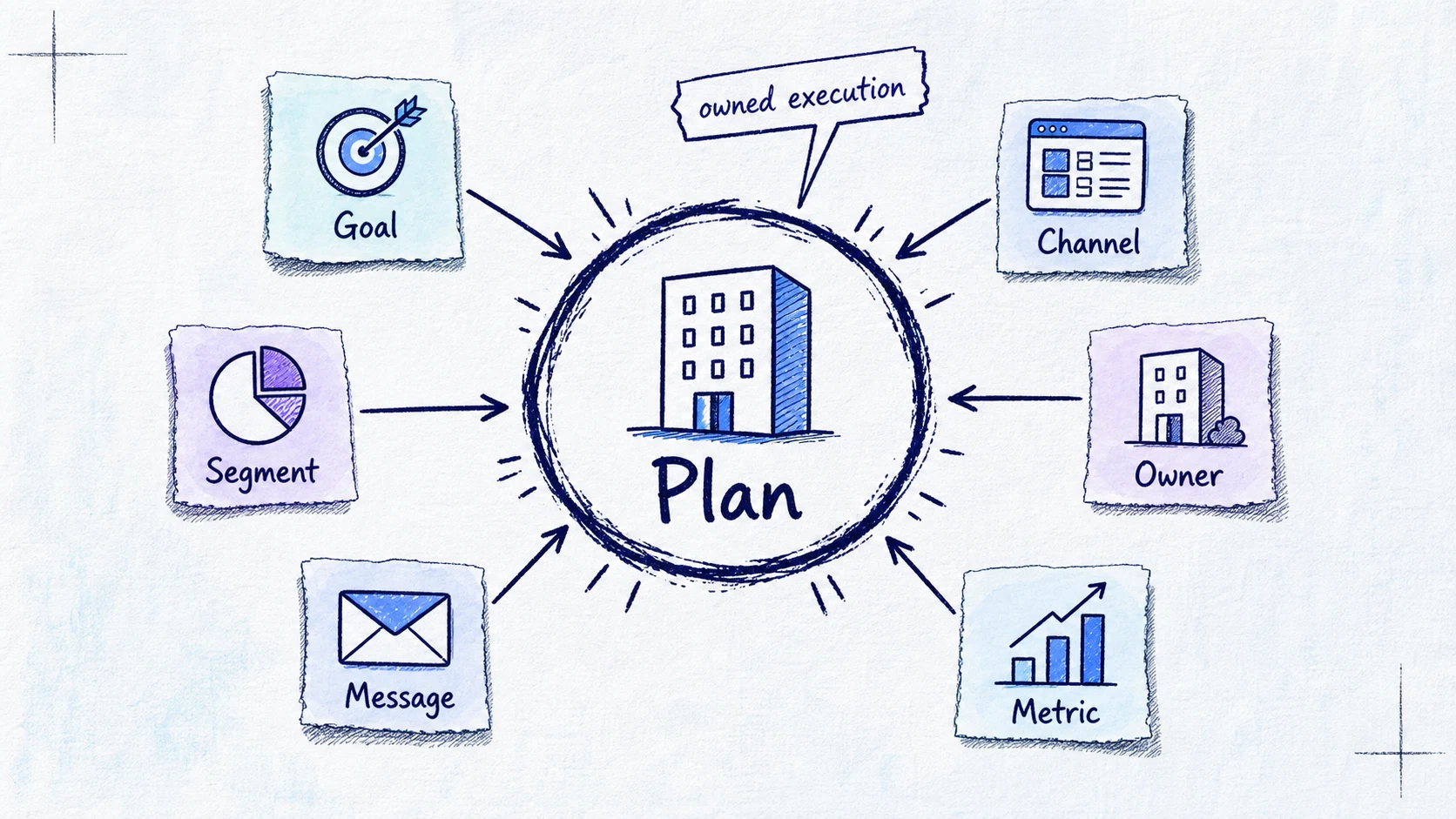
A useful plan usually contains seven parts.

First, the goal: the business outcome the team is trying to create, such as qualified pipeline, activation, expansion, or learning.
Second, the segment and buyer: the accounts and people the motion is built for.
Third, positioning and message: the problem, promise, alternative, and proof the team will lead with.
Fourth, channels: where the company will reach buyers, such as outbound, content, partnerships, events, community, or product-led acquisition.
Fifth, motion and assets: the steps, content, demos, sequences, offers, and handoffs needed to move a buyer forward.
Sixth, ownership and timing: who does what, by when, and which dependencies can block launch.
Seventh, measurement: the leading and lagging indicators the team will review.
SaaS example
Imagine a SaaS company launching a workflow tool for RevOps teams. The plan might target Series A and B companies, lead with CRM cleanup pain, use founder-led outbound and operator content, and aim to create 20 qualified conversations in six weeks.
The plan would assign account research, content, outreach, demos, CRM tracking, and weekly review to named owners. It would also define what qualifies as a real opportunity in the sales pipeline.
Common mistakes
The first mistake is writing a plan with no owner. Shared responsibility usually becomes delayed responsibility.
The second mistake is listing tactics without a market assumption. A channel calendar cannot fix unclear targeting.
The third mistake is measuring only output. Emails sent and pages published matter less than qualified conversations, buyer progress, activation, and revenue quality.
How we see it
A go-to-market plan should be easy to run and hard to misread. If the team cannot tell what it is betting on, who owns it, and what evidence will change the plan, the document is still a collection of intentions.