


What is RevOps?
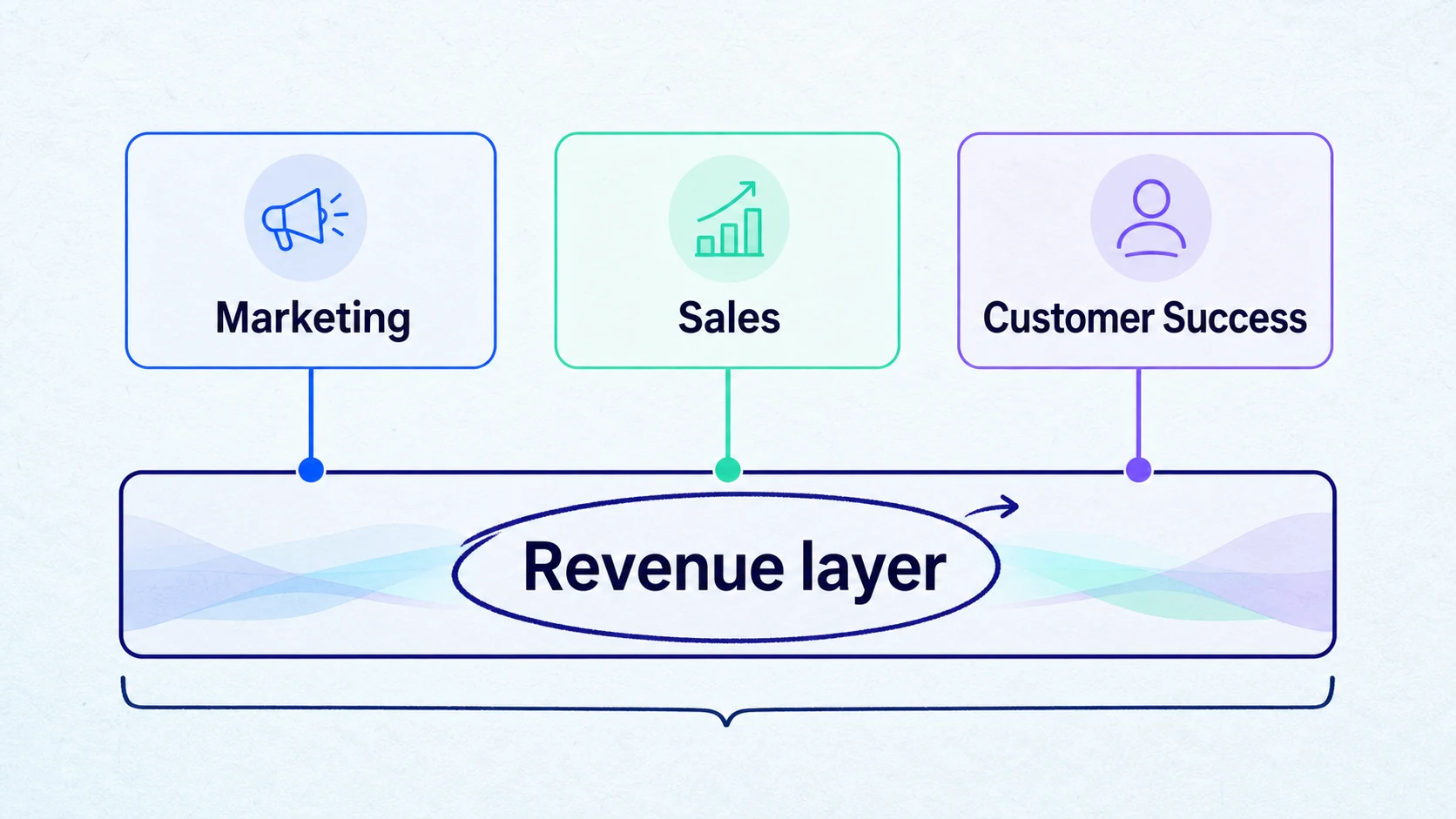
Revenue Operations (RevOps) is a centralized function that owns the data, processes, and systems supporting the entire customer lifecycle. It creates a unified operating model across marketing, sales, and customer success to drive accountability and predictable growth. This model moves beyond simple departmental alignment to establish shared ownership of the architecture behind revenue generation.
Many definitions focus on breaking down silos between go-to-market teams. While that is a consequence of good RevOps, the actual work is more technical and foundational. The function's mandate is to build and manage a single, reliable engine for revenue. Success is not measured by how well teams communicate, but by whether the entire revenue process is measurable, repeatable, and efficient.
The RevOps mandate: a unified operating model
In a traditional structure, marketing operations, sales operations, and customer success operations work independently. Each function optimizes for its own department's goals. Marketing ops focuses on lead volume and martech management. Sales ops concentrates on rep productivity and CRM hygiene. Customer success ops builds retention playbooks and ticketing systems.

This siloed approach creates friction and data gaps. Marketing may generate thousands of MQLs that the sales team finds unqualified. Sales may close deals with customers who are a poor fit, leading to high churn rates for the customer success team. Each team has its own data, its own tools, and its own version of the truth.
RevOps replaces this fragmented structure with a central operating layer. This team is not embedded within a single department; it serves the entire revenue organization. Its work is built on four pillars:
- GTM Technology: Managing the entire GTM technology stack as a single, integrated system. This includes the CRM, marketing automation platform, sales engagement tools, and customer success software.
- Process Design: Architecting and enforcing the processes that govern the customer lifecycle. This covers everything from lead routing and qualification to quoting, contracting, and renewal management.
- Data and Analytics: Establishing a shared revenue dataset with agreed field definitions. The RevOps team is responsible for data integrity, reporting, and delivering insights that inform strategic decisions.
- Enablement: Equipping GTM teams with the tools, information, and training they need to execute effectively. This is often done in partnership with dedicated sales or marketing enablement roles.
By centralizing ownership of these functions, RevOps ensures that the entire G-to-market motion operates from a shared playbook and a unified dataset.
Core responsibilities of a RevOps team
The day-to-day work of a RevOps function is tactical, technical, and strategic. While specific duties vary by company stage, they generally fall into a few key areas of ownership.
GTM technology and systems management
The RevOps team is the administrator of the company's revenue-generating tech stack. This is beyond managing user licenses. It involves designing the data architecture, building integrations between systems, and ensuring that technology serves a coherent GTM process. As GTM motions become more complex, this often requires specialized roles like a GTM Engineer to build and maintain the underlying infrastructure. A well-run stack ensures a smooth flow of data from the first marketing touchpoint through to renewal and expansion.

Data, analytics, and forecasting
RevOps is responsible for instrumenting the entire revenue funnel and producing reliable reporting. This function builds the dashboards that leaders use to track performance and makes sure the underlying data is accurate. Key responsibilities include:
- Defining and tracking key metrics: Customer Acquisition Cost (CAC), Lifetime Value (LTV), pipeline velocity, and Net Revenue Retention (NRR).
- Managing data integrity: Cleansing data, enforcing entry standards, and managing enrichment processes.
- Sales forecasting: Building and maintaining the models used to predict revenue, often working directly with finance and sales leadership.
- Performance analysis: Identifying bottlenecks in the sales pipeline and providing data-backed recommendations for improvement.
Process design and optimization
A RevOps team designs the rules of engagement for all GTM teams. They document and enforce standardized processes to make the revenue engine more efficient and predictable. Examples include:

- Lead lifecycle management: Defining the stages a lead passes through, the criteria for moving between stages (e.g., MQL to SQL), and the SLAs for follow-up.
- Rules of engagement: Clarifying territory assignments, lead ownership, and protocols for handling different types of accounts.
- Deal desk and quoting: Streamlining the process for creating quotes, managing approvals, and finalizing contracts to accelerate deal velocity.
Strategic planning and projects
As the keepers of revenue data and process, RevOps is a critical partner in strategic planning. The team provides the objective analysis needed to make informed decisions about market expansion, pricing changes, or GTM model adjustments. According to research from Salesforce, high-performing companies are more likely to have RevOps involved in strategic initiatives like go-to-market planning. This moves the function from a reactive support role to a proactive driver of strategy.
RevOps vs. Sales Ops: A clear distinction
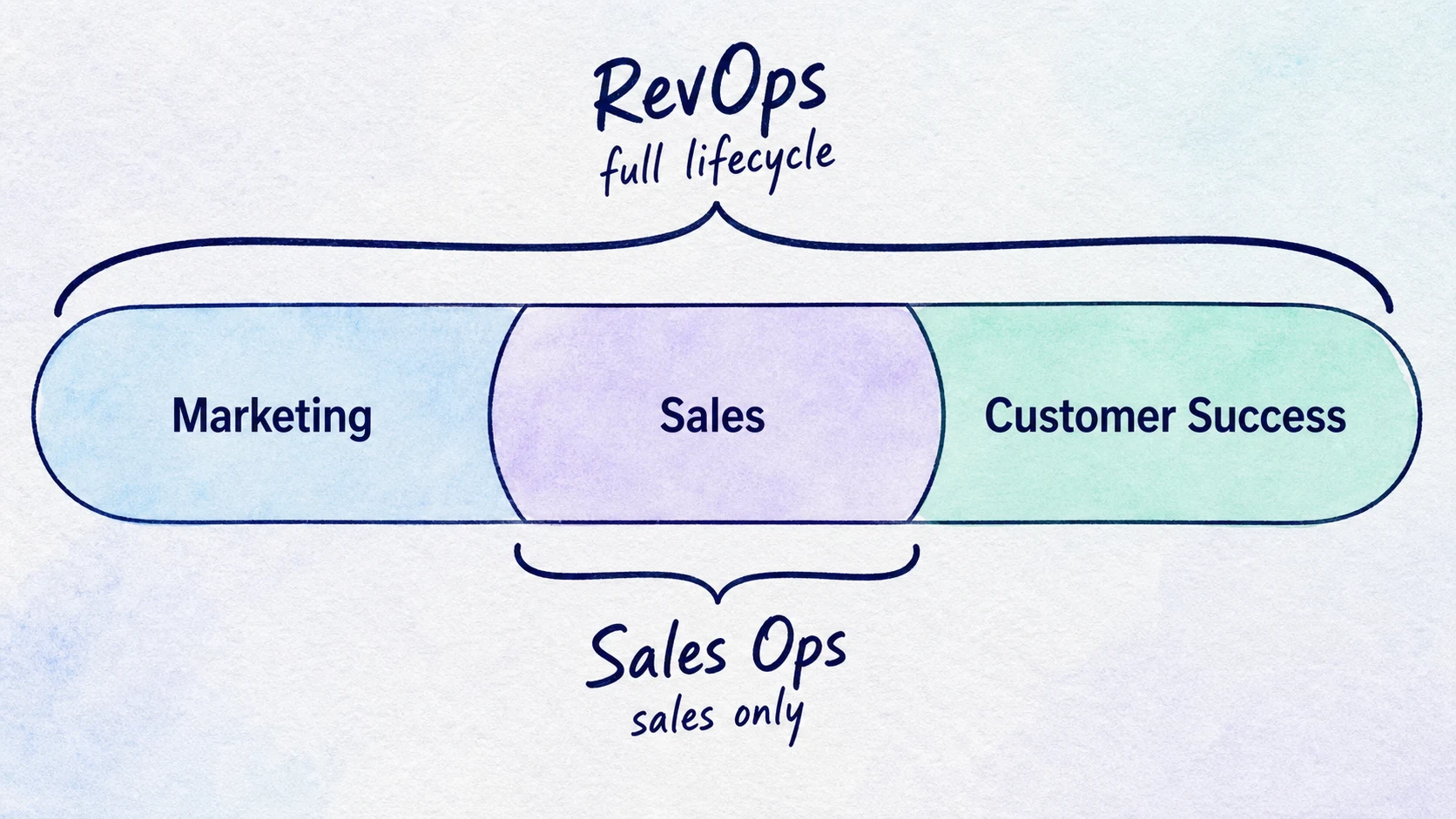
One of the most common points of confusion is the difference between RevOps and Sales Ops. While they share some skills, their scope and mandate differ.
Sales Operations is focused exclusively on maximizing the effectiveness and efficiency of the sales team. Its responsibilities are confined to the sales function and typically include:
- CRM administration for the sales team.
- Territory planning and quota setting.
- Sales compensation plan administration.
- Managing the sales pipeline and forecast.
- Sales-specific reporting and analytics.
Revenue Operations, in contrast, has a mandate that spans the entire customer lifecycle. It supports marketing, sales, and customer success, unifying their operations into a single cohesive motion. The key difference is one of scope: Sales Ops optimizes a single department, while RevOps optimizes the entire revenue engine.
As analysts at Gartner note, the goal of RevOps is to "align operations across the revenue-generating system." A useful way to frame the distinction is by the questions each function answers.
| Question | Sales Ops Focus | RevOps Focus |
|---|---|---|
| Who do we sell to? | How can we assign territories fairly to maximize sales coverage? | Which ICP segments have the highest LTV and lowest CAC across the entire customer lifecycle? |
| How is our pipeline? | Are reps creating enough opportunities to hit their quota this quarter? | What is our lead-to-close conversion rate, and where are the biggest drop-offs in the funnel? |
| Is our process working? | How can we reduce the time reps spend on administrative tasks? | What is the end-to-end customer lifecycle, and how can we create a frictionless experience from first touch to renewal? |
| What does the data say? | Which sales reps are performing best against their targets? | What is our Net Revenue Retention, and which customer cohorts are most likely to churn or expand? |
This broader view allows RevOps to solve systemic problems that Sales Ops, by its nature, cannot. For a detailed breakdown, see this comparison of RevOps vs. Sales Ops.
A practical framework for building RevOps
RevOps starts with a phased build of the revenue operating layer. Hiring a leader or buying another tool does not establish the function. The process has three stages.
Stage 1: Foundation (Unify)
The first step is to create one shared revenue dataset. This stage is focused on technology consolidation and data governance.
- Audit the tech stack: Map all the tools used by marketing, sales, and CS. Identify redundancies and integration gaps.
- Establish a central data warehouse: Consolidate data from the CRM, marketing automation platform, and other systems into one place.
- Define universal metrics: Create a master list of key business metrics and ensure every department uses the same definitions.
Stage 2: Orchestration (Standardize)
With a unified foundation, the next step is to build and enforce consistent processes across the entire customer lifecycle.
- Map the customer lifecycle: Document every touchpoint a customer has with the company, from awareness to advocacy.
- Standardize hand-offs: Implement clear SLAs and data requirements for moving leads and customers between teams.
- Automate workflows: Use the tech stack to automate repetitive tasks and ensure process compliance.
Stage 3: Acceleration (Optimize)
Once data and processes are reliable, the RevOps function can shift its focus to strategic optimization and growth.
- Build a predictive model: Use historical data to improve forecasting accuracy and identify leading indicators of success and failure.
- Run experiments: Develop a system for testing and measuring the impact of changes to pricing, messaging, or sales process.
- Provide strategic insights: Give leadership recommendations supported by revenue data to leadership on where to invest for future growth.
RevOps in day-to-day work: A B2B SaaS example
Consider a mid-stage B2B SaaS company, "MetricPath," that sells a performance monitoring tool. Before implementing RevOps, the company faced common growth challenges:
- Marketing was measured on generating MQLs. They hit their numbers, but the sales team complained that the leads were low-quality.
- Sales was focused on closing new logos. They often discounted heavily to win deals, leading to low initial contract values.
- Customer Success struggled with churn. Many new customers were not a good fit for the product and required extensive support before churning within the first year.
Each team was hitting its individual goals, but the business was struggling with inefficient growth and high churn. MetricPath hired a Head of RevOps to address these issues.
The first action was to unify the data. The RevOps team connected the CRM, marketing automation platform, and product analytics tool. With a complete view of the customer lifecycle, they discovered that the highest-value customers who expanded their contracts and rarely churned had all activated a specific product feature within their first 14 days.
Armed with this insight, the RevOps team redesigned the GTM process:
- They created a new "Product Qualified Lead" (PQL) definition. An MQL was not passed to sales until the user had activated the key feature.
- They adjusted sales compensation. Reps were now bonused on the first-year ACV and the customer's PQL status, discouraging deep discounts on poor-fit customers.
- They armed the CS team with a health score. This score, based on product usage data, allowed CS to proactively engage at-risk accounts before they churned.
The results were significant. MQL volume dropped, but the sales pipeline's close rate more than doubled. First-year churn decreased by 30%. By owning the data and process end-to-end, RevOps transformed MetricPath's GTM motion from a collection of siloed functions into a single, efficient revenue engine.
FAQ
When should a startup hire its first RevOps person?
Most startups make their first RevOps hire when they experience significant friction between sales and marketing, or when the founder can no longer manage the CRM and GTM processes alone. This typically happens around the 20- to 50-employee mark, or when scaling the GTM team becomes a primary company goal.
What are the most important RevOps metrics?
Key RevOps metrics span the entire funnel. Early-stage metrics include Lead-to-Opportunity Conversion Rate and Sales Cycle Length. Growth metrics include Customer Acquisition Cost (CAC) and Pipeline Velocity. Mature metrics focus on efficiency and retention, such as LTV:CAC Ratio, Magic Number, and Net Revenue Retention (NRR).
Does RevOps report to the CEO, CRO, or COO?
In smaller companies, the first RevOps leader often reports to the CEO or COO to ensure they have the authority to make cross-functional changes. In larger organizations with a Chief Revenue Officer (CRO), RevOps typically reports into the CRO, serving as their operational partner across marketing, sales, and customer success.
How does RevOps support customer success?
RevOps supports customer success by providing a complete view of the customer's history, from their first marketing interaction to their sales process. The function also designs the systems for tracking customer health, managing the renewal process, and identifying expansion opportunities, ensuring that post-sales teams have the data and workflows they need.
Can you have RevOps without a CRO?
Yes. A company can implement a RevOps function before hiring a CRO. In this scenario, the Head of RevOps acts as the operational glue between the heads of marketing, sales, and customer success, reporting to a CEO or COO. The function provides the shared data and processes that allow those leaders to work as a unified revenue team.
A well-executed RevOps function is the operational backbone of a scalable go-to-market strategy. It provides the systems, data, and processes necessary to drive predictable revenue and make smarter GTM decisions.
Want to build a sharper GTM motion? Subscribe to our newsletter for more guides and frameworks.