


SaaS sales funnel: Stages, metrics, and conversion logic
A SaaS sales funnel shows how a defined group of people, accounts, or product users advances through buying stages toward becoming customers. The useful operating model is a cohort measurement contract: choose one unit, require observable evidence at each gate, set a conversion window, and keep the counting rule stable.
That structure lets you see where movement changes without confusing buyer behavior, seller activity, acquisition cost, and post-sale health. It also gives every rate an audit trail back to an entity, event, timestamp, and definition.
What a SaaS sales funnel measures
A funnel measures movement within an eligible cohort. The cohort might be accounts that entered a target segment this month, users who started a trial this week, or workspaces that reached an activation event. Each later stage represents stronger buying evidence from the same type of entity.
Salesforce describes the sales funnel as the prospect's path from awareness to purchase and notes that buyers can move backward as well as forward. A measurement funnel can still use ordered events. The sequence describes how conversion is counted, not a claim that every buyer experiences a straight path.
For a subscription business, a new customer ends the acquisition funnel. Activation, retention, renewal, and expansion remain critical, but they answer post-sale questions. Combining every customer stage into one funnel makes it harder to tell whether acquisition conversion or retained revenue needs attention.
Sales funnel vs. pipeline, process, and lifecycle
These models can use some of the same records and timestamps, but they support different decisions.
| Model | Object and unit | Operator question | Output |
|---|---|---|---|
| Sales funnel | Eligible cohort of people, accounts, users, or workspaces | What share advances through defined buying evidence? | Conversion, leakage, and elapsed time by stage |
| Sales pipeline | Active opportunities or deals | What should a seller do next, and what may close? | Deal stage, next action, risk, and forecast state |
| Sales process | Repeatable seller activities and controls | How should the team execute the sale? | Plays, responsibilities, and required actions |
| Customer lifecycle | Contacts, companies, or customers across marketing, sales, and service | Where is each record in the broader relationship? | Lifecycle status, ownership, and cross-team routing |
A sales pipeline is a managed queue of active commercial work. Salesforce's pipeline guidance connects stages to exit criteria, next actions, and forecasting. The funnel uses stage events to compare cohorts; the pipeline uses deal state to manage current opportunities.
Lifecycle stages are broader CRM categories. HubSpot's lifecycle documentation shows configurable stages for contacts and companies, along with date-entered, date-exited, and time-in-stage properties. That is useful instrumentation, but the CRM's default labels do not have to become your funnel.
How to define SaaS funnel stages with evidence


There is no required stage count. Start with the buying evidence your motion can observe, then assign one owner to each definition. The following six-stage contract is an adaptable starting point for an account-based B2B motion.
| Stage | Entity | Entry evidence | Exit evidence | Owner | Primary metric |
|---|---|---|---|---|---|
| Target cohort | Account | Account enters a defined segment and period | Fit rule is satisfied | RevOps | Cohort size |
| Fit confirmed | Account | Required ICP criteria are verified | Relevant problem signal is recorded | SDR or operations | Stage conversion |
| Problem signal | Account | Declared demand or problem evidence occurs | Evaluation-start event occurs | SDR or marketing | Stage conversion |
| Active evaluation | Account | Buyer begins a real evaluation | Commercial-decision evidence is recorded | Account executive | Conversion and time to advance |
| Commercial decision | Account | Buying decision or binding commercial step is documented | New-customer event is recorded | Account executive | Stage conversion |
| New customer | Account | First valid purchase is completed | Acquisition funnel ends | Finance or operations | New customers |
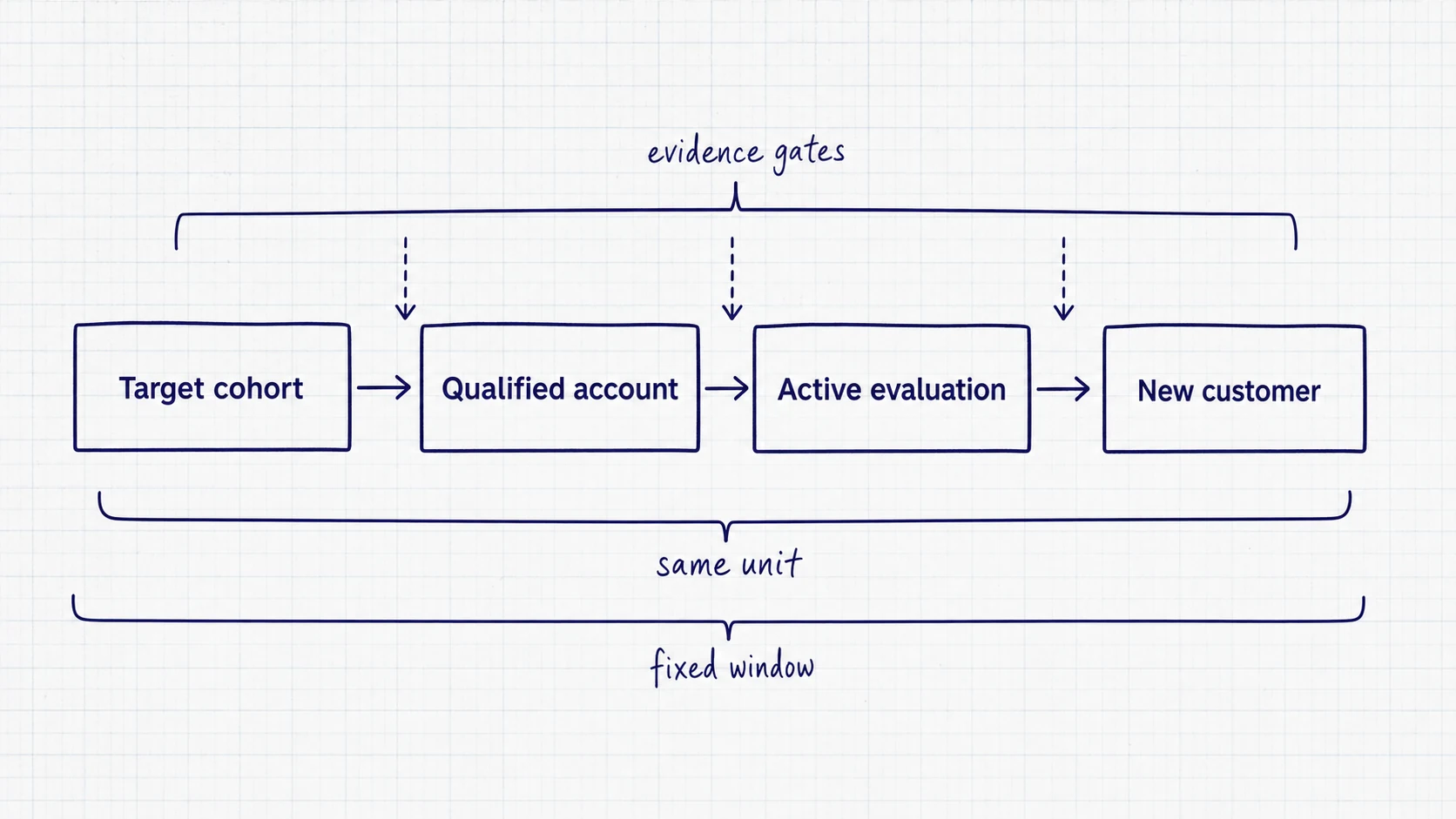
Stable stage definitions also expose where observed progression carries the most interaction burden. HockeyStack's analysis of more than 1.5 million B2B SaaS contacts reported averages of 54 touchpoints from first observed impression to MQL, 87 from MQL to pipeline creation, and 81 from pipeline creation to closed-won. The middle stage had the highest observed count in that dataset. Touchpoint burden is not conversion loss and does not identify a cause.
The stage names can change. The contract behind them should remain explicit. In a sales-led motion, an evaluation might begin with a qualified discovery meeting involving the buying group. In a product-led motion, it might begin when a workspace completes a meaningful product event.
Internal seller activity is not enough on its own. A rep sending an email, logging a call, or moving a CRM card shows work performed. It does not prove that the account supplied new buying evidence. Activities can be process requirements, while funnel advancement should depend on the declared exit event.
Ownership also applies to definitions, not merely records. Someone must decide what qualifies as fit, which event starts evaluation, and when a purchase counts. A practical RevOps guide can help place that governance across systems and teams.
Build the measurement contract

Write the counting rules before calculating conversion. A usable contract covers these decisions:
- Entity: Choose a person, account, opportunity, user, or workspace. Do not switch units between stages.
- Identity resolution: Define how contacts, domains, workspaces, and CRM accounts connect, including duplicate handling.
- Cohort start: Anchor membership to a declared entry event and period.
- Conversion window: Give every eligible entity the same amount of time to advance.
- Event order: Specify which events must occur and in what sequence for the measurement.
- Denominator: Count only entities eligible for the stage and window being analyzed.
- Exclusions and re-entry: Document test records, disqualified accounts, repeat trials, reopened deals, and other edge cases.
- Segmentation: Preserve source, segment, geography, product, and motion fields needed for comparison.
- Version and owner: Date every definition change and name the person responsible for the metric.
Amplitude's funnel analysis documentation illustrates the mechanics: a cohort begins with an entry event, later events follow an ordered rule, and conversion is evaluated within a defined window. The same discipline applies when the entity is an account in a CRM rather than a user in product analytics.
Do not change stage logic midway through a comparison. If a definition changes, version it and restate earlier data under the new rule where possible. Otherwise, apparent movement may come from the measurement change rather than buyer behavior.
SaaS funnel metrics and formulas
Choose the metric that answers the current question. A single funnel score cannot distinguish weak advancement, slow movement, rising acquisition cost, and poor retention.
| Question | Metric | Symbolic formula | Required boundary |
|---|---|---|---|
| What share advanced? | Stage conversion | Advanced entities / eligible entrants | Same entity, cohort, and window |
| What share did not advance? | Stage leakage | 1 – stage conversion | Same stage and matured window |
| How long did advancement take? | Median time to advance | Median of exit time – entry time | Defined converting cohort and stage boundary |
| What did acquisition cost? | CAC | Attributed acquisition spend / new customers | Defined period and attribution rule |
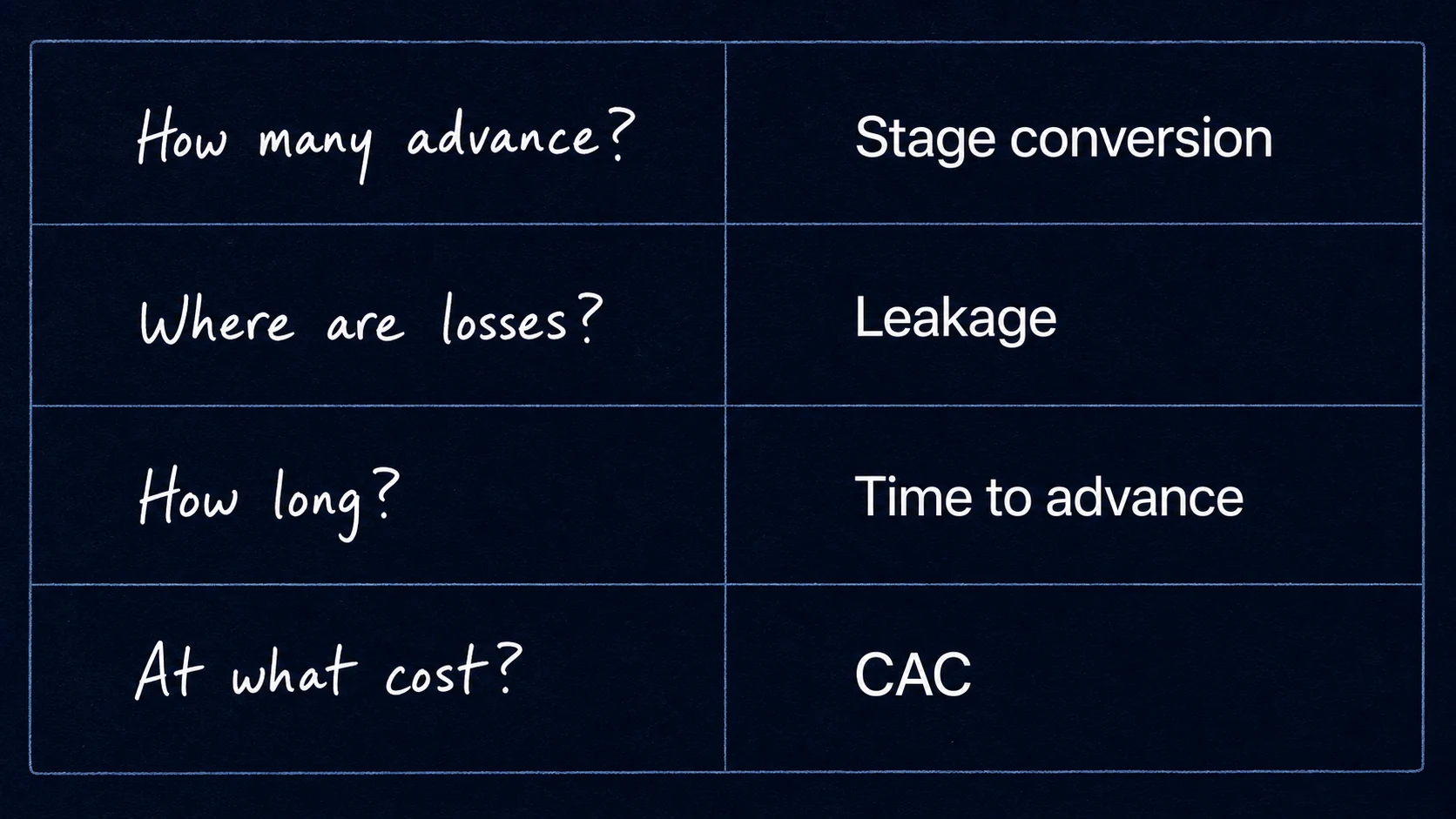
Stage conversion uses eligible entrants as its denominator, not every record in the database. Leakage is the complement of conversion only when both use the same matured cohort and are expressed as proportions. Median time to advance limits the influence of unusually long cases, but you still need to define which converted entities are included.
CAC connects funnel output to acquisition economics. Stripe's SaaS metrics guide separates acquisition measures such as CAC and lead-to-customer rate from retention measures such as churn and net revenue retention. Keep that boundary in your reporting. A cohort can convert well and retain poorly, or acquire slowly and retain strongly.
External benchmark rates are rarely comparable without aligned motion, segment, source, price, stage definitions, and measurement period. Start with mature internal cohorts under stable rules. Use an outside benchmark only when its methodology matches the question closely enough to support a valid comparison.
How to diagnose a conversion drop
Treat a drop as a description that deserves investigation, not as its own explanation.
- Validate instrumentation. Check event firing, timestamps, joins, duplicate rules, and stage-definition versions.
- Check cohort maturity. Confirm that every compared cohort has completed the conversion window.
- Compare segment mix. Look for changes in source, market segment, price band, product, geography, or motion.
- Inspect rate and time together. A stable conversion rate with slower advancement presents a different problem from an immediate increase in disqualification.
- Review qualitative evidence. Read loss reasons, call notes, product feedback, and qualification records from the affected segment.
- Test one suspected cause. Change one relevant part of the motion and evaluate a later mature cohort under the same rules.
A lower rate could reflect different traffic, stricter qualification, incomplete data, buyer timing, or execution. The funnel locates where measured movement changed. It does not establish why.
Sales-led, product-led, and hybrid funnels
Your go-to-market plan determines which unit and evidence make sense. Motion labels alone are not enough.
| Motion | Typical unit | Entry event | Qualification evidence | Conversion event | Sales handoff |
|---|---|---|---|---|---|
| Sales-led | Account or opportunity | Account enters target cohort | Fit plus buyer-confirmed problem | New-customer event | Early, often before evaluation |
| Product-led growth | User or workspace | Signup, invite, or trial start | Meaningful product event | Paid workspace or account | Optional, based on declared product evidence |
| Hybrid | Workspace linked to account | Product or market entry event | Product evidence plus account fit | New-customer event | Explicit product-to-sales event |
Hybrid funnels need careful identity resolution. A user acts inside a workspace, the workspace belongs to an account, and sales may create an opportunity for that account. Preserve those links so product usage does not become an unexplained lead score and the opportunity does not lose its product history.
A fictional SaaS example
Consider a hypothetical collaboration SaaS company that chooses the account as its acquisition unit. An account enters the target cohort when it matches the selected segment. Fit is confirmed after required firmographic and operating criteria are verified. A problem signal records relevant demand. Active evaluation begins only when the buying group starts a documented evaluation. A commercial decision requires explicit purchase evidence, and the first valid subscription creates the new customer.
Operations owns the definitions and identity rules. The SDR owns fit and signal evidence. The account executive owns evaluation and commercial evidence. A separate product funnel counts invited users, activated workspaces, and retained usage. Those records connect to the account, but they do not replace its acquisition denominator.
Common funnel mistakes
- Mixing units: Counting people at entry, opportunities in the middle, and accounts at purchase makes the rates uninterpretable.
- Using activity-only stages: Seller tasks can enforce process, but they do not prove buyer advancement.
- Comparing immature cohorts: Recent entrants have had less time to convert and will appear weaker.
- Changing definitions mid-period: The metric then compares two counting systems.
- Copying external benchmarks: A target without matching scope can create false urgency or hide a real issue.
FAQ
What are the stages of a SaaS sales funnel?
Stage count varies by motion. A useful sequence is target cohort, fit confirmed, problem signal, active evaluation, commercial decision, and new customer. Adapt the evidence at each gate to your motion while keeping the entity consistent from entry to conversion.
What is the difference between a SaaS sales funnel and a sales pipeline?
A SaaS sales funnel measures how a defined cohort converts between buying stages. A sales pipeline organizes active opportunities by deal stage so sellers can manage next actions, deal risk, and forecast state. The two models can share events without serving the same purpose.
How do you calculate SaaS funnel conversion rate?
Divide the entities that complete the next-stage event by eligible entrants from the same cohort and conversion window. State whether the entity is a person, account, opportunity, user, or workspace. Exclude records according to a documented rule that stays stable across comparisons.
What is a good SaaS funnel conversion rate?
There is no credible universal rate. Compare mature internal cohorts with the same motion, segment, source, price range, stage definitions, and conversion window. An external benchmark is useful only when its sample and counting rules align closely enough with your model.
Does a product-led SaaS company need a sales funnel?
Yes. The funnel may count users or workspaces and use product events such as activation rather than lead labels. If sales assists some accounts, define the event that creates the handoff and preserve the link among the user, workspace, account, and opportunity records.
Should retention be part of the SaaS sales funnel?
Treat retention as a connected post-sale system when the funnel is meant to measure new-customer acquisition. Include retention inside the same model only when it is explicitly labeled as a broader revenue lifecycle. This keeps acquisition conversion and retained revenue as separate operating questions.
Get practical GTM systems breakdowns in the GTMpreneur newsletter.